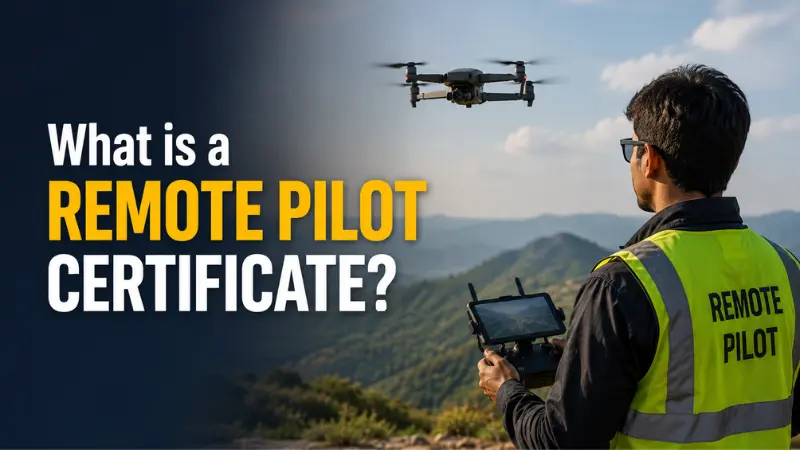
What is a Remote Pilot Certificate (RPC) and Why Every Drone Pilot in India Needs One
Quick Summary
- A Remote Pilot Certificate (RPC) is the government-issued credential that legally authorises you to fly commercial drones in India, issued through DGCA-approved training organisations.
- You need an RPC to operate any Small, Medium, or Large category drone, and also for any commercial use of a Micro drone.
- Getting an RPC involves a 5 to 7 day training programme at an approved institute, covering ground school, simulator sessions, and live flight practice.
- Flying without an RPC can result in fines up to Rs. 25,000, cancellation of your registration, and in serious cases, criminal proceedings.
If you are thinking about a career in drone flying, or if you already own a drone and want to use it professionally, there is one document you cannot do without: the Remote Pilot Certificate.
In India, you cannot legally fly a commercial drone without it. It does not matter how long you have been flying, how expensive your drone is, or how skilled you are. Without a valid RPC, you are operating outside the law.
But the certificate is not just a formality. It is proof that you understand how to handle a drone safely in Indian airspace, that you know the rules, and that you can be trusted with a machine that can weigh anywhere from 2 kg to over 100 kg in the air above people, fields, and buildings.
This guide covers everything you need to know about the Remote Pilot Certificate in India: what it is, who needs it, how to get it, and what happens if you do not have one.
What Exactly Is a Remote Pilot Certificate?
The Remote Pilot Certificate (RPC) is a legal credential issued by the Directorate General of Civil Aviation (DGCA), which is the government body that oversees all civil aviation in India. The RPC authorises you to operate specific categories of drones in Indian airspace for commercial purposes.
The certificate is issued under the Drone Rules 2021, which replaced the older and far more complicated UAS Rules from the same year. Under Part VI of the Drone Rules 2021, specifically Rule 31, no person is allowed to operate an unmanned aircraft system for commercial purposes without holding a valid RPC that is registered on the Digital Sky Platform.
Until 2022, it was called a Remote Pilot Licence. The Drone (Amendment) Rules 2022 changed the name to Remote Pilot Certificate and, more importantly, shifted the responsibility of issuing it from the DGCA directly to DGCA-approved training organisations called RPTOs. This made the whole process faster and more accessible.
Your RPC is not a generic permit. It specifies the exact category and type of drone you are authorised to fly, whether that is a Small multirotor, a Medium category agricultural sprayer, or a fixed-wing surveying drone.
Who Needs an RPC?
| Drone Category | Weight | Non-Commercial Use | Commercial Use |
|---|---|---|---|
| Nano | Up to 250g | No RPC needed | Registration required |
| Micro | 250g to 2kg | No RPC needed | RPC required |
| Small | 2kg to 25kg | RPC required | RPC required |
| Medium | 25kg to 150kg | RPC required | RPC required |
| Large | 150kg to 500kg | RPC required | RPC required |
If you own a Nano drone (under 250g) and you fly it purely for fun, you do not need an RPC or even registration. But the moment you use that drone to earn money, say by filming a wedding or shooting a product video, the rules change.
For Micro drones (250g to 2kg), the same logic applies for purely recreational flying. No RPC is needed. But any commercial use triggers the requirement.
For Small, Medium, and Large drones, there is no exemption at all. Whether you are flying recreationally or professionally, you need an RPC, a registered Unique Identification Number (UIN) on your drone, and valid third-party insurance.
In short: if you want to earn from flying a drone in India, you need an RPC, no matter what size drone you use.
Who Can Apply? The Eligibility Criteria
Before you can start training for an RPC, you need to meet four basic requirements set out under Rule 33 of the Drone Rules 2021.
Age: You must be at least 18 years old and not more than 65. The lower limit is because you need to be legally accountable for your actions. The upper limit follows general aviation standards around physical and cognitive fitness.
Education: You must have passed Class 10 (matriculation) from a recognised board. The drone training curriculum covers aerodynamics, weather conditions, airspace rules, and aviation law. A Class 10 qualification ensures you have the basic literacy and numeracy to understand these topics.
Identity Proof: You need a valid government-issued ID. After the Drone (Amendment) Rules 2023 removed the passport requirement, you can now use your Aadhaar card, Voter ID, PAN card, or Driving Licence. This was a major change that opened the door for rural operators and farmers who rarely hold a passport.
Medical Fitness: You need a basic medical fitness certificate from a registered MBBS doctor. The check covers your eyesight (both near and distant), colour vision, hearing, and overall fitness. Since most drone flying in India is done within visual line of sight, your ability to clearly see and track the drone matters a lot.
What Is an RPTO and Why Does It Matter?
An RPTO, or Remote Pilot Training Organisation, is a training academy that has been approved by the DGCA to conduct drone pilot training and issue RPCs. The DGCA sets the standards, but the RPTOs do the actual work of training and examining pilots.
Think of it this way: the DGCA is like the exam board, and the RPTO is like the school. You attend the school, complete the training, pass the tests, and the RPTO issues your initial certificate. The DGCA then processes and formally registers it on the Digital Sky Platform within 15 days.
Not every drone training institute qualifies as an RPTO. To get DGCA approval, an organisation needs certified instructors, DGCA-approved simulators, a dedicated outdoor flying area in a green zone, and a documented training manual. The approval is valid for 10 years, with regular audits in between.
This is why choosing a DGCA-approved RPTO matters so much. Only training completed at an approved institute counts toward your RPC. Training anywhere else, no matter how good it may seem, will not get you certified.
CIGPL is a DGCA-approved RPTO based in Hapur, Uttar Pradesh. You can check our certifications and approvals to see exactly what we are authorised to offer.
How to Get Your RPC: Step by Step
Getting your Remote Pilot Certificate follows a clear, structured process. Here is how it works from start to finish.
Step 1: Check Your Eligibility
Step 2: Choose a DGCA-Approved RPTO
Step 3: Submit Your Documents
Step 4: Complete Ground School
The first part of training is classroom-based. You will cover topics including:
- Drone Rules 2021 and Indian airspace laws
Basic principles of flight and how drones stay airborne - Aviation weather and how wind, humidity, and temperature affect drone performance
- Green, Yellow, and Red airspace zones
- Emergency procedures and risk management
- Logbook maintenance and payload management
Step 5: Simulator Training
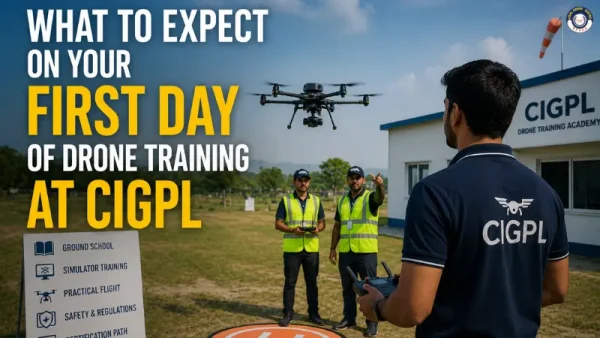
Step 6: Practical Flight Training
Step 7: Pass the Exam
Step 8: Receive Your RPC
Once you pass, your RPTO uploads your results to the Digital Sky Platform. Your initial RPC is generated by the platform, and the DGCA formally processes and registers it within 15 days. From that point, you are legally authorised to fly commercially.
The whole training programme typically takes 5 to 7 days depending on the drone category.
The Digital Sky Platform: How It Connects to Your RPC
The Digital Sky Platform is the government’s central system for managing all drone operations in India. It is run by the DGCA and available at digitalsky.dgca.gov.in.
Your RPC only becomes legally valid once it is registered on this platform. This is also where your drone’s UIN (Unique Identification Number) lives, where you check airspace zones before every flight, and where you log your flight plan before taking off commercially under the No Permission No Takeoff (NPNT) protocol.
NPNT means exactly what it sounds like. For commercial drones, the flight controller firmware is linked to the Digital Sky Platform. If you have not filed a valid flight plan, or if your planned route goes into a restricted zone, the platform will not issue a digital clearance token. Without that token, the drone’s motors physically will not arm.
This is why your RPC and your Digital Sky registration go hand in hand. One without the other does not get you off the ground legally.
How Long Does the RPC Last and How Do You Renew It?
Your Remote Pilot Certificate is valid for 10 years from the date of issue. It is not a lifetime certificate, and it is not automatically renewed.
To renew it, you need to go back to a DGCA-approved RPTO before the 10 years are up. The renewal process is not just a paperwork exercise. You have to complete a refresher course that updates you on any changes to the Drone Rules, new airspace protocols, and advances in drone technology. After the refresher, you take a re-examination. Once you pass, the RPTO processes the renewal and your RPC is extended for another 10 years.
If you commit a serious violation, the DGCA can suspend or cancel your RPC before the 10 years are up.
What Can You Do With an RPC? Career and Salary
Once you have your RPC, a wide range of commercial opportunities open up across several sectors.
Agriculture: Agricultural drones used for spraying pesticides, herbicides, and fertilisers fall mostly in the Small category. With India’s push to modernise farming, certified drone pilots are in high demand from agri-service companies and cooperatives.
Surveying and Mapping: Government programmes like SVAMITVA have used drones to survey and map over 3 lakh villages across India. Drone pilots trained in photogrammetry and grid flying are needed for this kind of work. Our Surveillance and Mapping Drone Course is designed specifically for pilots who want to work in this field.
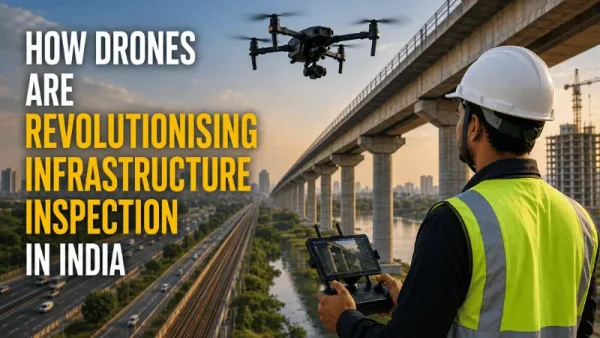
Infrastructure Inspection: Power grids, pipelines, towers, and bridges are increasingly being inspected using drones. This requires skilled pilots who can navigate complex environments safely.
Media and Real Estate: Commercial filmmakers and real estate companies hire certified drone pilots for aerial photography and videography.
Logistics: Drone-based delivery, especially in remote areas, is an emerging field that requires certified pilots for supervised operations.
In terms of earnings, entry-level certified pilots in India typically earn between Rs. 15,000 and Rs. 30,000 per month. Experienced specialists working in agriculture, thermal inspections, or high-end cinematography can earn between Rs. 50,000 and Rs. 1,00,000 per month. Freelance operators working on a project basis can charge between Rs. 5,000 and Rs. 20,000 per assignment.
The training cost at an RPTO generally ranges between Rs. 30,000 and Rs. 65,000, making the return on investment quite good for most candidates.
What Happens If You Fly Without an RPC?
| Violation | Maximum Penalty |
|---|---|
| Flying commercially without an RPC | Rs. 25,000 |
| Flying with an unregistered drone | Rs. 50,000 |
| Flying in a Red Zone without permission | Rs. 1,00,000 |
| Endangering people or property | Up to 2 years imprisonment |
Beyond financial penalties, the DGCA can cancel your drone’s registration and your RPC. For flights near military areas or sensitive installations, authorities can permanently confiscate the drone and initiate criminal proceedings under the Bharatiya Vayuyan Adhiniyam 2024.
For companies running drone fleets, the fines are multiplied based on the size of the organisation, so the consequences are even heavier at the business level.
Recent Changes: 2025 and 2026 Updates
Passport removed as a requirement (2023): The 2023 amendment removed the need for a passport to get an RPC. Any government-issued ID now works. This was a major step toward making certification accessible to rural operators.
NPNT fully enforced (2026): The No Permission No Takeoff protocol, which was earlier being rolled out in phases, is now strictly enforced across all commercial drones above Nano category. Every commercial flight must be pre-logged on the Digital Sky Platform.
Drone import restrictions: Importing fully assembled drones is still restricted to encourage local manufacturing. However, drone components can be imported freely. The government has backed domestic manufacturing with a Rs. 2,000 crore Production Linked Incentive scheme running from 2025 to 2028.
GST reduced to 5%: The GST on drones has been brought down to a flat 5%, making drones more affordable for operators and businesses.
Draft Civil Drone Bill 2025: A new bill proposing a standalone drone law is under consultation. If passed, it would introduce stricter penalties including imprisonment for serious violations, and could require Type Certification even for Nano drones and R&D prototypes. As of 2026, the Drone Rules 2021 remain in force.
India by the numbers (early 2026):
- 38,575+ registered drones
- 39,890+ DGCA-certified remote pilots
- 244 approved RPTOs across the country
Frequently Asked Questions
Can I fly a drone for fun without an RPC?
How long does the RPC training take?
Do I still need a passport to apply?
No. Since the 2023 amendment, you can use a Voter ID, Ration Card, Driving Licence, PAN card, or Aadhaar card instead.
Is the RPC valid all over India?
Can I fly a drone from another country using my foreign licence?
What if my RPC expires?
Does my drone also need to be registered separately?
Summary
The Remote Pilot Certificate is not just a piece of paper. It is the foundation of a legitimate drone career in India. It proves that you have been trained to a national standard, that you understand the airspace you are operating in, and that you can be held accountable for your actions.
Getting one takes about a week at a DGCA-approved RPTO. The eligibility requirements are simple: you need to be between 18 and 65, have a Class 10 qualification, a valid government ID, and a basic medical fitness certificate. Once you have your RPC, it stays valid for 10 years and opens doors across agriculture, mapping, media, infrastructure, and logistics.
India now has over 39,000 certified drone pilots and that number is growing fast. The demand across industries is real, the government is actively supporting the sector, and the salaries reflect that.
If you are ready to get started, our drone training programmes are designed to take you from beginner to DGCA-certified pilot in a structured, practical setting. And if you want to specialise in survey-grade work, take a look at what the Remote Pilot Certificate course at CIGPL covers in detail.
The certification process is straightforward. The opportunity is real. All you need to do is take the first step.