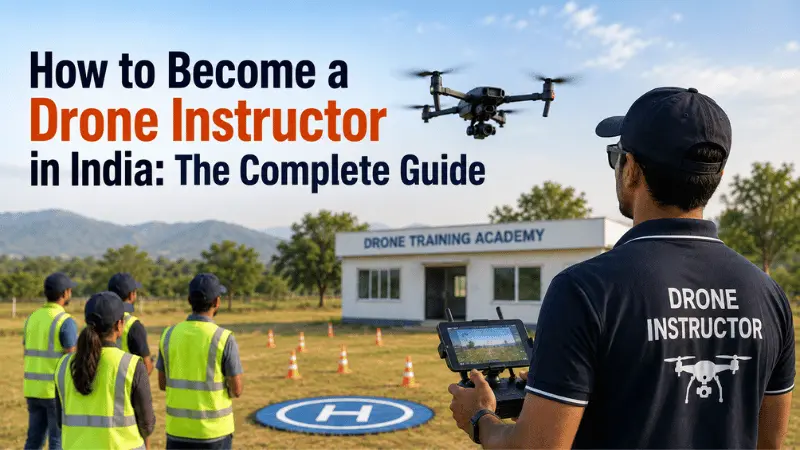
How to Become a Drone Instructor in India: The Complete Guide
Quick Summary
- To become a DGCA-certified drone instructor, you need a degree or diploma, a valid Remote Pilot Certificate, a minimum of 20 hours of logged flight experience, and completion of the Train the Trainer (TTT) programme.
- India currently has only 700 to 1,200 active certified instructors against a national requirement for 1,00,000 trained pilots. The shortage is severe and the job security that comes with it is exceptional.
- Certified instructors earn Rs. 40,000 to Rs. 70,000 per month in stable, fixed-location roles with corporate benefits, without the equipment costs and income unpredictability of field operations.
- You cannot teach and issue official drone licences independently. All certified training must happen through a DGCA-approved RPTO.
Most people entering the drone industry are focused on one thing: getting certified and getting to work. But there is a second career path that very few people consider at the start, and it turns out to be one of the most stable and rewarding in the entire industry.
Teaching others how to fly.
India needs 1,00,000 certified drone pilots to meet the demands of agriculture, infrastructure, government mapping, and logistics. It currently has under 40,000. Every one of those missing pilots has to be trained by someone. That someone is a DGCA-certified Remote Pilot Instructor, and right now, the country has only 700 to 1,200 of them.
If you are a certified pilot thinking about your long-term options, or someone planning your career from scratch, this guide covers exactly what it takes to become a drone instructor in India.
What a Drone Instructor Actually Does
A drone instructor at a DGCA-approved RPTO is responsible for taking complete beginners through the full 5-day Remote Pilot Certificate course.
The first two days are classroom-based. You deliver theory sessions covering the Drone Rules 2021, airspace zones, aviation weather, radio telephony, payload handling, and safety management. These sessions run for 14 to 17 hours and cover everything a new pilot needs to understand before they touch a drone.
Day three moves to the simulator lab. You supervise a minimum of 3 hours of simulator sessions, watching how students handle basic controls, assessing their spatial awareness, and teaching them approach and landing protocols without any real-world risk.
Days four and five are at the outdoor flying field. Using a dual-controller master-slave setup, you oversee live flights and can take immediate control if a student makes a dangerous error. You guide students through hovering, square circuits, figure-of-eight patterns, and disorientation recovery drills. The course ends with a 20-minute practical test that you administer and verify.
After a student passes, you log their results in the Digital Sky Platform and the RPTO initiates the Remote Pilot Certificate issuance.
The Requirements: What You Need Before You Apply
The bar to become an instructor is meaningfully higher than getting an RPC. Here is what the DGCA requires under Rule 34 of the Drone Rules 2021 and Drone Training Circular 01 of 2023.
Educational qualification: You need either a degree from a UGC or AICTE-recognised university, a three-year technical diploma from a recognised institute, or a valid aviation licence such as a PPL, CPL, AME, or ATC licence.
A valid Remote Pilot Certificate: You must already hold an RPC for the specific drone category and class you want to teach. You cannot instruct on Small category drones without a Small category RPC.
20 hours of flight experience: You need a minimum of 20 logged hours of Remotely Piloted Aircraft flying for the relevant class before you can apply for the DGCA oral examination. These must be verified hours on record.
Completion of the Train the Trainer programme: This is the instructor-specific course that teaches you how to teach, not just how to fly.
The Train the Trainer Programme
The TTT programme is where the actual qualification happens. It is not available everywhere. Only RPTOs that have been operating for at least six months, maintained a completely accident-free record, and have already generated a minimum of 100 certified pilots in the relevant category are authorised to run it.
The duration depends on where you are starting from.
| Your Current Status | TTT Duration | Typical Cost |
|---|---|---|
| Have RPC and 20 hours flight experience | 3 to 5 days (17 hours) | Rs. 30,000 to 35,000 |
| Have RPC but need flight hours | 6 days | Rs. 40,000 to 50,000 |
| Need RPC and full training | 11 to 15 days | Rs. 50,000 and above |
The curriculum is not just advanced flying. It focuses heavily on how people learn, how to recognise when a student is cognitively overloaded, how to safely simulate emergency failures during training flights, and how to document and assess competency against DGCA standards.
After completing the TTT course, you face a practical skill test administered by a Master Instructor and then a formal oral examination by a DGCA-constituted board. You get two attempts at each. A 30-day cooling period applies between attempts.
Basic Instructor vs Master Instructor
There are two tiers within the instructor framework.
A Remote Pilot Instructor is authorised to teach standard RPC candidates at an approved RPTO. This is the role most instructors fill day to day.
A Master Instructor is authorised to run TTT courses and train other instructors. The requirements are considerably higher: you must already be an approved instructor, have successfully trained at least 100 RPC candidates, hold 200 total hours of drone flying experience (100 of those in the preceding six months), and pass a separate DGCA board assessment.
Master Instructors are extremely scarce, which is exactly why the shortage of new instructors is so difficult to solve quickly. New instructors can only be produced through TTT courses. TTT courses can only be taught by Master Instructors. And Master Instructors take years of consistent instructional work to develop organically.
What You Can Earn
A certified drone instructor working full-time at a DGCA-approved RPTO earns between Rs. 40,000 and Rs. 70,000 per month. That works out to Rs. 4.8 to Rs. 8.4 LPA.
Beyond the salary, the role offers something that field operations rarely do: stability. You work from a fixed campus, keep regular hours, and receive standard corporate benefits including Provident Fund and health insurance. You also avoid the personal costs that field pilots carry, such as hardware depreciation, battery replacement, travel expenses, and personal insurance.
Master Instructors, because of their scarcity and the legal requirement for their presence in any TTT-approved RPTO, hold considerable negotiating leverage and often earn well above the base instructor range.
One Rule You Cannot Work Around
You cannot issue official drone licences independently. This is non-negotiable.
Under Rule 34 of the Drone Rules 2021, only authorised RPTOs have access to the Digital Sky Platform portal required to register candidates, administer official exams, and trigger certificate issuance. A qualified instructor working outside an approved RPTO can teach recreational flying or basic skills, but they cannot generate a legally valid commercial Remote Pilot Certificate. Any pilot who trains through an unauthorised setup and tries to fly commercially is in violation of federal aviation law.
Your instructor rating is also tied to your affiliated RPTO. If you leave the organisation, your credentials may need to be re-linked to a new approved institute before you can continue teaching commercially.
FAQs
Not necessarily. A UGC or AICTE-recognised degree in any subject works. A three-year technical diploma is also accepted, as are existing aviation licences like PPL, CPL, or AME.
No. You need a minimum of 20 hours of verified flight experience after getting your RPC before you are eligible to apply for the TTT programme.
For someone who already holds an RPC and 20 hours of experience, the TTT course takes 3 to 5 days. Add the DGCA oral board preparation and scheduling, and the full process typically takes 6 to 8 weeks from start to finish.
Yes, and it is growing fast. As RPTOs expand into Tier-2 and Tier-3 cities to support schemes like Namo Drone Didi, the demand for local instructors in non-metro locations is increasing significantly.
The instructor rating is valid for 10 years, or until your base RPC expires, whichever comes first. Mandatory refresher training is required every two years to maintain the rating.
Summary
Becoming a drone instructor is one of the most secure and professionally rewarding paths in India’s drone industry. The combination of a genuine skills shortage, a high institutional barrier to entry, stable employment conditions, and growing national demand makes it a career worth serious consideration.
The path starts the same way for everyone: with a DGCA Remote Pilot Certificate and flight hours. If you have not taken that step yet, our Remote Pilot Certificate course at CIGPL is the right starting point. Take a look at our full drone training programmes to see how we structure the pathway from first flight to full certification.
The industry needs more instructors than it currently has. The people who get qualified now will be in a strong position for a long time.