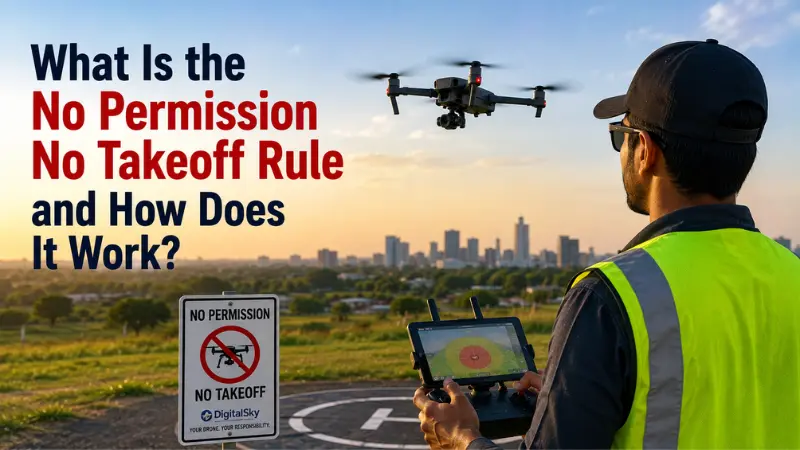
What Is the No Permission No Takeoff Rule and How Does It Work?
Quick Summary
- No Permission No Takeoff (NPNT) is a mandatory rule in India that physically prevents a drone’s motors from starting unless the pilot has received a digitally signed flight permission from the government’s Digital Sky Platform.
- The system works through a cryptographic file called a Permission Artefact that the drone checks against its own location, altitude, and time before allowing takeoff.
- Nano drones under 250g are exempt. Small, Medium, and Large category drones are subject to full NPNT enforcement. Most commercially used drones in India fall into this group.
- DJI drones are not natively NPNT-compliant in India, and bypassing the system carries fines up to Rs. 1,00,000 plus the risk of criminal arrest without a warrant.
Think of NPNT the way you might think about a car immobiliser. Just as a car will not start without the right digital signal from an authorised key, an NPNT-compliant drone will not start without a digitally verified permission from the government’s central system.
This is not a voluntary check or a paper-based approval. The system is built into the drone’s firmware. Without the correct digital file in place, the motors stay locked. The drone physically cannot take off.
India introduced this concept as early as 2018, making it one of the first countries in the world to embed airspace compliance directly into drone hardware rather than relying on pilots to self-report or on post-flight enforcement. This article explains how the system works in plain terms, which drones are covered, what happens when someone tries to bypass it, and what changes are coming under the proposed new drone law.
Why NPNT Was Created
Before NPNT, enforcing drone regulations in India followed the same model as most other countries: you set rules, you hope pilots follow them, and you investigate violations after the fact. The problem with this model is that by the time you investigate, someone may have flown near a military base, over a crowded stadium, or across an international border.
The DGCA’s solution was to move enforcement from after the flight to before the flight, and specifically to embed that enforcement into the drone itself. Instead of a drone being free to take off anywhere and an inspector finding out later, the firmware refuses to arm the motors at all unless the national digital system confirms the flight is authorised.
The rule was first introduced in August 2018 under DGCA Civil Aviation Requirements. It was retained and simplified under the Drone Rules 2021, which is the framework still in force as of 2026. Under this framework, NPNT serves two distinct purposes: protecting national security by preventing unauthorised flights near sensitive areas, and safely managing low-altitude unmanned traffic that shares airspace with manned aircraft.
How NPNT Actually Works: The Simple Version
Before each commercial flight, a pilot must obtain a digital file from the government’s Digital Sky Platform. This file, called a Permission Artefact, is essentially a digital certificate that says: “This specific drone is authorised to fly within this GPS boundary, below this altitude, during this time window.”
When the drone is powered on, its internal software reads this file and checks:
- Does the file belong to this drone’s registered identification number?
- Are the current GPS coordinates inside the approved boundary?
- Is the current time within the approved window?
- Is the file genuinely signed by the Digital Sky Platform (not forged)?
Only if all four checks pass will the firmware release the motors. If any check fails, the motors stay locked and an error code appears on the pilot’s ground control screen.
This entire check happens automatically, in seconds, before the pilot can do anything.
The Technical Mechanism in Plain Language
For those who want to understand the engineering behind it without a computer science degree, here is how the components fit together.
The Permission Artefact: This is an XML file (a type of structured digital document) that contains the approved flight parameters and a cryptographic digital signature. Think of the signature as a government seal that cannot be faked. It encodes the drone’s unique ID, the GPS polygon boundary, the maximum altitude (up to 120 metres in uncontrolled zones), and the permitted time window.
The Registered Flight Module (RFM): This is a secure hardware or software component inside the drone that acts as the gatekeeper. It reads the Permission Artefact, verifies the digital signature using cryptographic keys, checks the real-time GPS and altitude data, and either allows or blocks the takeoff. More sensitive operations require a tamper-resistant physical hardware module so the keys cannot be extracted or the software manipulated.
The Takeoff Handshake: When you try to arm the drone, the RFM runs a rapid automated sequence. It verifies the file’s digital signature, checks that the drone’s current position matches the approved area, confirms the time is within the window, and only then releases the firmware lock on the motors. This all happens in seconds.
The audit trail: Every flight generates a log that is signed with the drone’s own cryptographic key. This makes the records tamper-evident. If something goes wrong, authorities can verify exactly where the drone flew, whether it exceeded its boundary, and whether any failsafe was triggered.
Which Drones Are Subject to NPNT?
The rule applies based on weight category under the Drone Rules 2021.
| Category | Weight | NPNT Status |
|---|---|---|
| Nano | Up to 250g | Exempt in Green Zones below 50 feet. No RPC, UIN, or insurance required for recreational use. |
| Micro | 250g to 2kg | Limited application. UIN required. Non-commercial use in Green Zones uses a simpler notification process rather than full NPNT. Commercial use triggers full requirements. |
| Small | 2kg to 25kg | Strictly enforced. Full NPNT hardware and firmware compliance mandatory. RPC and insurance required. |
| Medium | 25kg to 150kg | Strictly enforced. Same as Small. Used in heavy agriculture and logistics. |
| Large | Above 150kg | Strictly enforced, plus additional clearances under the Aircraft Rules. |
The vast majority of commercially used drones in India are Small category, which means full NPNT compliance is the norm for professional operations.
Certain categories are entirely exempt from civilian NPNT: military drones, intelligence agency platforms, and drones used by R&D entities operating within their own controlled premises in Green Zones.
Step by Step: How a Pilot Gets a Permission Artefact
Here is the practical process a certified pilot follows before every commercial flight.
Step 1: Check the airspace map. The pilot logs into the Digital Sky Platform and checks the interactive colour-coded airspace map for the planned location. Green Zones permit flight below 400 feet without manual intervention. Yellow Zones require ATC clearance. Red Zones cannot be entered at all.
Step 2: Submit the flight plan. The pilot enters the GPS coordinates of the planned flight area, the altitude, the date and time window, and the UIN of the drone to be used.
Step 3: Wait for the system response. For Green Zone flights, the system evaluates the request automatically and generates the Permission Artefact almost instantly. For Yellow Zones, the request goes to Air Traffic Control for manual review. No artefact is generated until ATC approves.
Step 4: Download the artefact. Once approved, the pilot downloads the digitally signed XML file to their ground control device (laptop or smart controller).
Step 5: Inject the artefact into the drone. Using the ground control software, the pilot transfers the file to the drone’s RFM storage module.
Step 6: Power on and fly. The drone powers on, the RFM runs the Takeoff Handshake, all checks pass, the motors unlock, and the pilot can fly within the approved parameters.
What Happens in Areas Without Mobile Connectivity?
This is a practical concern because high-value operations in agriculture, pipeline inspection, and forest surveying often happen in remote areas without reliable internet.
The system has a solution called the Handshake Window. A pilot can generate and download the Permission Artefact while connected to the internet in a city or town before travelling to the remote site. The file is cached locally on the ground control device. At the remote site, with no internet connection, the drone still performs the full cryptographic check against the locally stored artefact. The validation happens entirely offline between the ground station and the drone’s RFM.
This means pilots should always plan ahead. Generate your artefact before you leave connectivity, not when you arrive at a field 50 kilometres from the nearest tower.
What Happens If You Try to Fly Without It?
If the Permission Artefact is missing, expired, or invalid when you attempt takeoff, the RFM blocks the motors from arming. An error code appears on your ground station display. The drone does not move.
If a pilot intentionally modifies the firmware to bypass this lock, the consequences are severe.
| Violation | Maximum Fine | Type of Offence |
|---|---|---|
| Flying unregistered drone (no UIN) | Rs. 25,000 | Administrative |
| Commercial flight without RPC | Rs. 25,000 | Administrative |
| Yellow Zone breach without clearance | Rs. 1,00,000 | Administrative |
| Red Zone breach or NPNT bypass | Rs. 1,00,000 | Cognizable, non-compoundable (arrest without warrant) |
The most serious violations, specifically Red Zone breaches and active NPNT bypass attempts, are classified as cognizable and non-compoundable offences. This means the police can arrest you on the spot without needing a court warrant, and you cannot simply pay a fine to settle the matter. You must face criminal prosecution.
Your insurance also becomes void the moment you fly outside the system. If your drone crashes while operating without a valid Permission Artefact, your insurer will not pay out. You are personally liable for all damages.
Green, Yellow, and Red Zones in the NPNT System
The NPNT system handles each airspace zone differently.
Green Zones: The vast majority of India’s airspace. Flights below 400 feet are automatically approved by the Digital Sky system without any human intervention. The Permission Artefact is generated algorithmically and almost instantly.
Yellow Zones: Controlled airspace, typically within 8 to 12 kilometres of airports, above 400 feet in Green Zones, or near helipads and military airbases. The NPNT system blocks the Permission Artefact entirely until a human Air Traffic Controller reviews and approves the flight plan. You cannot fly in a Yellow Zone without this manual clearance.
Red Zones: Strictly prohibited. No Permission Artefact can be generated for any flight plan that enters a Red Zone. The system rejects it automatically. Red Zones include military bases, nuclear facilities, international borders, and specific sensitive government locations. Temporary Red Zones can also be declared by state governments during VIP movements or security events, and these update the Digital Sky map in real time.
One important nuance: Digital Sky permission and site-specific permission are not the same thing. Flying over an Archaeological Survey of India heritage site requires separate written permission from the ASI, even if the location falls within a Green Zone and the Digital Sky platform approves your flight plan. Both permissions are required.
Why DJI Drones Are a Complication in India
DJI is the world’s largest drone manufacturer and dominates global markets. In India, they present a specific regulatory problem.
DJI advocated for an alternative compliance approach they called “No Notification, No Takeoff,” which relied on pilot self-declaration rather than the cryptographic firmware lock required by the DGCA. DJI declined to integrate India’s Registered Flight Module requirements into their hardware.
Because India also banned the import of fully assembled foreign drones in 2022 (to promote domestic manufacturing under the PLI scheme), DJI drones are not natively NPNT-compliant and are difficult to legally procure for new commercial use. This has created friction for sectors like high-end cinematography and 3D mapping that traditionally relied on DJI’s camera quality.
Domestic manufacturers like ideaForge, Asteria Aerospace, and Garuda Aerospace build NPNT compliance into their platforms natively, which is why government tenders and commercial enterprise contracts now effectively require domestically manufactured hardware.
How NPNT Evolved From 2018 to 2026
The system did not work perfectly from the start.
2018 to 2020: NPNT was mandated on paper but barely functional in practice. Foreign manufacturers refused to rebuild their global firmware for a single market. The Digital Sky Platform struggled under the processing load. The commercial drone industry essentially stagnated.
2021 to 2022: The government overhauled the rules, launched the PLI scheme to force domestic manufacturing, and banned fully assembled drone imports. This compelled the market to shift to indigenously manufactured, NPNT-compliant platforms.
2023 to 2026: The enforcement matured significantly. NPNT compliance became a non-negotiable filter for government tenders and large commercial contracts. By February 2026, the system records over 38,500 UIN-registered drones and 39,890 certified pilots operating within the framework.
What the Draft Civil Drone Bill 2025 Proposes to Change
The current Drone Rules 2021 are subordinate legislation. The Draft Civil Drone (Promotion and Regulation) Bill 2025 proposes to replace them with primary parliamentary law, and the changes to enforcement are significant.
Under the proposed law, bypassing the NPNT system to fly in restricted airspace would be elevated to a criminal offence carrying up to three years in prison plus fines. Local police would gain expanded powers to confiscate equipment on the spot without a warrant if a violation is suspected, even before any formal investigation.
The Bill also introduces strict liability for drone accidents: if your drone causes injury or death while operating outside the NPNT framework, you are liable regardless of intent. Minimum statutory compensation would be set at Rs. 2.5 lakhs for death and Rs. 1 lakh for grievous hurt.
The industry has raised concerns that treating minor technical failures such as connectivity issues, firmware glitches, or unintentional geofence nudges as criminal acts could penalise legitimate operators. As of 2026, the Bill remains under consultation and the Drone Rules 2021 remain in force.
How India's Approach Compares Globally
India’s NPNT is notably more restrictive than most other countries’ approaches.
| Country | System | Pre-Flight Lock? | Philosophy |
|---|---|---|---|
| India (DGCA) | NPNT | Yes, hardware-enforced | Zero-trust: cannot fly without state permission |
| USA (FAA) | Remote ID | No | Trust but verify: fly freely, broadcast identity |
| EU (EASA) | U-space Remote ID | Partial (in designated zones) | Track in flight, enforce post-incident |
| Canada | SAFE Envelope | Limited | OEM geofencing, specific operations |
India assumes every unauthorised flight is a potential threat and requires cryptographic proof of authorisation before the drone can physically start. The FAA and EASA allow drones to fly in uncontrolled airspace freely, relying instead on continuous broadcast identification that lets authorities identify and pursue violations in real time or after the fact.
Neither model is wrong. They reflect different regulatory priorities and risk assessments. India’s approach is more aggressive in preventing unauthorised flights; Western models are more permissive but maintain accountability through transparency.
FAQs
NPNT prevents a drone's motors from starting unless the pilot has received a valid, digitally signed flight permission from the government's Digital Sky Platform. Without the permission file, the drone physically cannot take off.
Nano drones under 250g are exempt for recreational use in Green Zones. Micro drones in non-commercial Green Zone use have a lighter notification process. Small, Medium, and Large category drones require full NPNT compliance for all commercial operations.
You can generate the Permission Artefact before leaving a connected area and cache it on your ground control device. The drone will complete the validation handshake offline against the locally stored file at the remote site.
No. DJI drones are not natively NPNT-compliant and are also affected by the 2022 ban on fully assembled drone imports. Using DJI hardware for new commercial operations in India creates significant regulatory complications.
The RFM monitors your position throughout the flight. If you approach the boundary edge, the firmware can prevent further movement in that direction or trigger a Return-to-Home sequence depending on your hardware configuration. An accidental minor breach is different from intentional bypass, but both are recorded in the tamper-evident flight log.
Not necessarily. Certain heritage sites managed by the Archaeological Survey of India require separate written permission from the ASI, independent of Digital Sky. Both approvals are required before flying legally at these locations.
Yes. The Draft Civil Drone Bill 2025 proposes prison sentences of up to three years for bypassing NPNT to fly in restricted airspace, up from the current maximum administrative fine of Rs. 1,00,000. The Bill has not yet been passed as of 2026.
Summary
NPNT is one of the most distinctive features of India’s drone regulatory framework. While most countries rely on identity broadcasting or post-flight accountability, India enforces airspace compliance at the firmware level: if you do not have the government’s digital permission loaded into the drone, the motors do not start.
For certified commercial pilots operating legally, NPNT is simply part of the pre-flight routine: check the airspace map, generate the Permission Artefact for your planned area, load it into the drone, and fly within the approved parameters. The system is designed to be efficient for compliant operations, with automatic approvals in Green Zones happening almost instantly.
Understanding how NPNT works is part of what you learn during your Remote Pilot Certificate training. The Digital Sky Platform, airspace zones, Permission Artefacts, and NPNT compliance are all covered in the ground school curriculum at CIGPL and every DGCA-approved RPTO. Take a look at our full drone training programme to understand what the course covers.
Flying legally in India means working with this system, not around it.