How Drones Are Transforming Agriculture in India
Quick Summary
- India’s agricultural drone market was valued at USD 302 million in 2025 and is projected to reach USD 2.18 billion by 2034, growing at nearly 24% annually.
- Drones complete in 7 to 10 minutes what takes a manual crew 4 to 6 hours per acre, using 90% less water and 30 to 40% fewer chemicals.
- Government schemes like Namo Drone Didi and SMAM offer subsidies of up to 80% on drone purchases, making entry affordable for farmers and rural entrepreneurs.
- A certified agricultural drone pilot running their own service business can earn a net annual income of Rs. 8 to 22 lakhs, with the investment recovered within the first year.
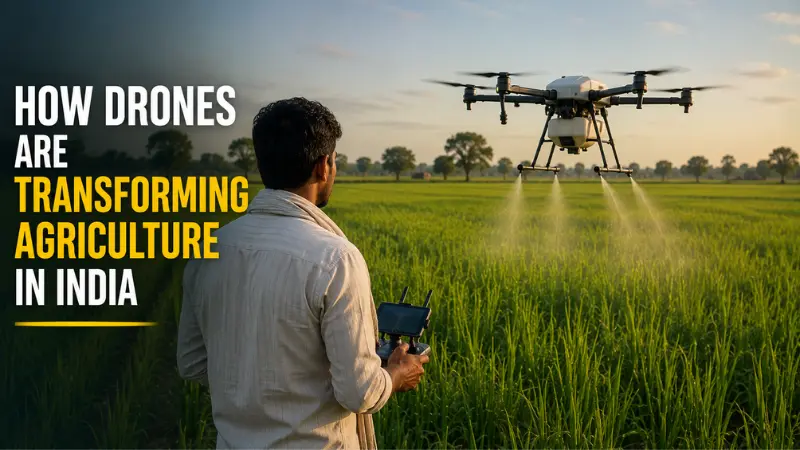
Walk through any paddy field in Tamil Nadu or a cotton farm in Maharashtra today and you might notice something that was unthinkable five years ago: a drone hovering steadily above the crop canopy, spraying in precise rows while a single operator watches from the edge of the field with a tablet.
No labourers wading through ankle-deep mud. No chemicals soaking into someone’s skin. No crop trampled underfoot. Just a 10-litre machine covering an acre in under 10 minutes.
This is what the agricultural drone revolution in India actually looks like on the ground. It is not a pilot programme or a government demonstration. By 2026, it is becoming standard practice across multiple states, multiple crop types, and multiple income levels. And it is only getting started.
Where Indian Agriculture Was Stuck
Before understanding what drones are doing for Indian farming, it helps to understand the problem they are solving.
India’s agricultural workforce has been shrinking for years. In Tamil Nadu alone, agricultural workforce participation fell from 43% to 22% in less than a decade. The farmers who remain are aging. Migrant labour is becoming harder to find and more expensive to hire. In states like Haryana, the MGNREGS wage floor has crossed Rs. 374 per day, which means hiring a manual crew to spray a 5-acre farm costs Rs. 1,500 to Rs. 2,000 in labour alone, before accounting for chemicals.
Manual spraying also has a serious crop protection problem. A fungal outbreak or pest surge that is spotted on a Monday may not be treated until Friday if you are waiting for a manual crew. By then, the infestation can spread from 20% of the field to 60%. That difference in timing can wipe out a significant portion of the season’s income.
Drones change both of these equations at the same time.
What Agricultural Drones Actually Do
Most people associate drones with cameras and photography. Agricultural drones do something quite different. Here are the main ways they are being used across Indian farms right now.
Pesticide and Fertiliser Spraying
This is the biggest application by volume and the primary revenue source for most rural drone service operators. Agricultural drones use Ultra-Low Volume (ULV) technology, spraying micro-droplets of 60 to 200 micrometers through intelligent nozzles. The powerful downward airflow from the rotors pushes chemicals deep into the crop canopy, reaching both the upper and lower surfaces of the leaves.
The difference in efficiency compared to manual spraying is dramatic. A manual crew covers 1 to 2 acres per day. A single drone covers up to 50 acres per day. The drone uses 8 to 10 litres of water per acre. Manual spraying uses 210 to 250 litres per acre.
Crop Health Monitoring Using NDVI Analysis
Drones equipped with multispectral cameras can detect crop stress that is invisible to the human eye. These cameras capture light in the near-infrared and red-edge wavelengths, and the data is processed into a Normalized Difference Vegetation Index (NDVI) map. A drop in NDVI in a specific zone of the field signals fungal blight, nitrogen deficiency, or pest activity days or weeks before any visible damage appears.
This early warning system allows farmers to treat only the affected zones rather than blanket-spraying the entire field, saving both money and the environment.
Soil Analysis and Pre-Sowing Mapping
Before the sowing season, drones map the field’s topography and soil conditions using 3D photogrammetry. These maps highlight variations in soil composition, moisture retention, and elevation. Farmers use this data to optimise drainage, plan irrigation, and apply soil amendments only where needed.
Irrigation Management
Drones with thermal sensors detect heat variations in the crop canopy caused by water stress. When plants close their stomata to conserve moisture, their canopy temperature rises slightly. Thermal imaging picks up these micro-gradients, identifying failing irrigation lines or drought-stressed zones before visible wilting sets in.
Seed Sowing and Broadcasting
Heavy-payload drones with rotating granular spreaders can broadcast seeds, urea granules, and even fish feed in aquaculture ponds from the air. For flooded paddy fields, aerial seed broadcasting completely replaces the gruelling process of manual rice transplantation, saving labour during critical seasonal windows.
Crop Yield Estimation
By combining time-series multispectral data with AI-based crop models, drones help Farmer Producer Organisations and agribusinesses predict harvest volumes weeks in advance. This allows them to plan cold storage, logistics, and advance contracts well before harvest.
Disaster and Crop Insurance Mapping
After floods, cyclones, or droughts, drones rapidly map damage across large areas and generate geotagged aerial datasets. This objective, verifiable data speeds up insurance claim settlements under schemes like the Pradhan Mantri Fasal Bima Yojana, replacing slow and often contested manual ground surveys.
Manual Spraying vs. Drone Spraying: The Numbers
The case for switching to drones becomes very clear when you look at the specific comparisons.
| Parameter | Manual Spraying | Drone Spraying |
|---|---|---|
| Coverage speed | 1 to 2 acres per day | Up to 50 acres per day |
| Time per acre | 4 to 6 hours | 7 to 10 minutes |
| Water per acre | 210 to 250 litres | 8 to 10 litres |
| Chemical savings | High wastage from over-spraying | 30 to 40% reduction |
| Operator health risk | Direct pesticide exposure | Zero, remote operation |
| Crop damage | Trampling, soil compaction | No physical contact |
| Cost per acre | Rs. 500 to 1,000+ | Rs. 300 to 700 |
The 95% time saving is the most immediately valuable benefit for most farmers. During an acute pest outbreak, speed of response directly determines how much crop is saved.
The Drones Doing This Work in India
Because of India’s Make in India policy, foreign drones are excluded from the government subsidy ecosystem. The domestic market is dominated by DGCA-certified Indian manufacturers. Here are the models most widely used in 2026.
| Drone Model | Payload | Daily Coverage | Flight Time | Price (Pre-Subsidy) |
|---|---|---|---|---|
| Garuda Kisan 16L | 16 litres | Up to 50 acres | 7 to 12 min | Rs. 6.0 to 8.0 lakh |
| IoTechWorld Agribot A5/A6 | 10 litres | 25 to 30 acres | 20 min | Rs. 3.5 to 5.0 lakh |
| Marut AG365 | 11 litres | 30 to 45 acres | 22 min | Rs. 9.89 to 10.0 lakh |
| ideaForge Agri Series | 10 to 15 litres | 30 to 40 acres | 10 to 15 min | Rs. 7.0 to 10.0 lakh |
| Garuda Kisan 8L | 8 litres | 15 to 25 acres | 7 to 15 min | Rs. 4.5 to 5.5 lakh |
Most of these are hexacopters designed with swap-and-go battery systems, allowing pilots to cycle through multiple battery packs in the field and maintain continuous operations throughout the day.
Government Schemes Making This Affordable
The single biggest barrier to agricultural drone adoption in India has been upfront cost. The government has addressed this through several overlapping schemes.
Namo Drone Didi
This central scheme with a Rs. 1,261 crore outlay targets women-led Self Help Groups (SHGs). It provides an 80% subsidy (capped at Rs. 8 lakhs) on a complete drone package including the aircraft, four spare battery sets, a fast charger, insurance, and a 15-day pilot training course. As of February 2026, over 1,094 drones have been distributed to women SHGs under this scheme. The women who receive these drones run them as service businesses, charging farmers per acre and earning independent income.
Sub-Mission on Agricultural Mechanization (SMAM)
SMAM provides tiered subsidies based on the applicant type. Research institutions and agricultural universities get 100% subsidy (up to Rs. 10 lakhs). Farmer Producer Organisations and cooperatives get 75% subsidy (up to Rs. 7.5 lakhs). Individual farmers and Custom Hiring Centre operators get 40 to 50% subsidy (up to Rs. 5 lakhs), with the higher 50% rate reserved for SC/ST farmers, women, and small and marginal landholders.
Agriculture Infrastructure Fund (AIF)
For buyers who need to finance the remaining cost after subsidies, the AIF provides collateral-free loans of up to Rs. 2 crore with a 3% annual interest subvention. This is specifically designed for FPOs and rural entrepreneurs setting up drone service businesses.
GST Reduction
In September 2025, GST on all civilian drones was cut to a flat 5%, down from the earlier 18 to 28% range. This directly reduced the purchase price for everyone in the supply chain.
Which States and Crops Are Leading the Way?
Adoption is not uniform across India. A few states and crop types are significantly ahead.
Tamil Nadu and Andhra Pradesh are the frontrunners. The southern states have seen the sharpest rural labour shortages, which made the economics of drone adoption compelling very quickly. Tamil Nadu’s agricultural universities actively list drone spraying services at benchmarked rates of Rs. 800 per acre. The paddy cultivation zone is particularly suited to drones because flooded fields make manual spraying both slow and physically demanding.
Maharashtra is the leader for commercial crops. Dense, tall-growing sugarcane and cotton fields are practically impossible for manual sprayers to navigate in the late growing season. The state government has actively distributed Marut AG365 drones to farmers in districts like Buldhana, and operators in these areas are reporting consistent monthly earnings of Rs. 60,000 to 70,000.
Punjab and Haryana dominate for scale. The large, consolidated wheat and mustard fields of the north are ideal for high-throughput drone operations, where the 50-acres-per-day capacity of modern agricultural drones makes a genuine operational difference.
What Agricultural Drone Pilots Actually Earn
Running a drone spraying service as a business is one of the more financially attractive rural enterprises available in India right now.
Pilots charge Rs. 300 to 700 per acre depending on the state, crop type, and local competition. At 25 to 50 acres per day, the daily gross revenue ranges from Rs. 7,500 to Rs. 35,000 during active agricultural windows.
| Scenario | Acres/Day | Operating Days/Month | Charge/Acre | Net Monthly Profit |
|---|---|---|---|---|
| Conservative | 25 | 15 | Rs. 350 | Rs. 1.02 lakh |
| Moderate | 35 | 20 | Rs. 450 | Rs. 2.70 lakh |
| Optimistic | 50 | 25 | Rs. 550 | Rs. 6.21 lakh |
Even in the conservative scenario, a dedicated agricultural drone pilot can recover their entire investment within 18 to 24 months. Under moderate conditions, payback happens in 8 to 12 months.
What Certifications and Skills Do You Need?
To operate an agricultural drone commercially in India, you need two things sorted.
DGCA Remote Pilot Certificate (RPC): This is the legal requirement. You need to complete the RPC course at a DGCA-approved RPTO, which covers aviation law, airspace rules, meteorology, and practical flight training. You can learn more about the Remote Pilot Certificate course at CIGPL if you want to get started.
Agronomic knowledge: Beyond the RPC, agricultural pilots need to understand the chemicals they are handling. This includes knowing toxicity levels, calculating dilution ratios correctly, calibrating spray nozzles for different crop types, and following the PPQS Standard Operating Procedures that govern aerial chemical application in India.
Field maintenance skills: Rural environments are dusty and humid. Pilots who cannot clean clogged nozzles, recalibrate flight systems, and manage battery health in the field spend too much time grounded. Hardware maintenance is a practical daily skill, not an optional extra.
Real Case Studies from Indian Fields
The following are not projections. They are documented outcomes from real field operations.
Paddy farming in Needamangalam, Tamil Nadu: A 9-acre paddy field was sprayed by drone versus manual knapsack crew. The drone completed the entire field in 1.2 hours. The manual crew took 34.3 hours. The drone used 72 litres of water. The manual crew used 240 litres. Both achieved identical crop protection results.
Nano-urea on maize in Pondicherry: A study comparing drone spraying with tractor-mounted gun sprayers for liquid nano-urea on maize found identical crop health outcomes between both methods. However, the drone used 95% less water and completely eliminated operator exposure to the chemical. Farmers in the study saw their net income per acre increase from Rs. 15,931 to Rs. 22,960.
Cotton farming in Buldhana, Maharashtra: FPOs and independent operators using Marut AG365 drones under the SMAM scheme reported consistent net earnings of Rs. 60,000 to Rs. 70,000 per month during the cotton and soybean seasons.
The Challenges That Still Exist
It would not be honest to write about agricultural drones without acknowledging the real limitations.
Battery life is short. Most agricultural drones fly for 10 to 22 minutes per battery at full payload. Pilots need to carry 4 to 6 battery packs and cycle them through fast chargers throughout the day. Batteries also degrade after 500 to 1,000 cycles and cost Rs. 15,000 to 18,500 each to replace.
Farmer awareness remains uneven. Institutional adoption is high, but many smallholder farmers are still unfamiliar with the technology or sceptical about trusting algorithms with their crops. This requires patient, localised demonstration before adoption happens.
Fragmented land is harder to work. India’s farms are often very small. On plots under 2 acres, the drone spends too much time turning and repositioning relative to actual spraying. The economics work best on larger or more consolidated plots.
Weather dependency. High winds cause chemical drift. Rain stops operations entirely. Extreme heat risks overheating avionics. Agricultural drone operators need to plan their working months around monsoon periods and seasonal weather patterns.
What Is Coming Between 2026 and 2030
Three developments will significantly change agricultural drone operations over the next few years.
Spot spraying with Edge AI: Drones are being developed with onboard AI processors that can visually identify individual weeds or diseased plants in real time and open specific nozzles for milliseconds to treat only the affected biomass. This could reduce chemical usage by 50% or more compared to current blanket application.
Autonomous swarming: As BVLOS regulations mature, a single certified pilot will be able to manage a fleet of 3 to 8 drones operating simultaneously across large farms. This multiplies daily coverage capacity without adding proportional labour costs.
Hybrid and heavy-lift drones: 30-litre and 50-litre capacity variants are being developed for large plantation crops. Hybrid VTOL designs with internal combustion or hydrogen fuel cell systems will extend flight times to 90 minutes or more, solving the battery endurance problem for remote operations.
FAQs
Drone services typically cost Rs. 300 to Rs. 700 per acre, which is often equal to or cheaper than manual labour when you factor in the higher wage floors, water costs, and chemical wastage from uneven application. Most farmers who switch to drone services find the cost comparable or better within the first season.
Individual farmers can get 40 to 50% subsidy under SMAM (up to Rs. 5 lakhs). Farmer Producer Organisations can get 75%. Women-led SHGs can get 80% under the Namo Drone Didi scheme. The Agriculture Infrastructure Fund covers remaining costs through low-interest loans.
Yes. You need a DGCA Remote Pilot Certificate obtained through a certified RPTO, along with a UIN for the drone and valid third-party insurance. You also need practical knowledge of agricultural chemicals and spray calibration.
Drones use 8 to 10 litres per acre. Manual spraying uses 210 to 250 litres per acre. That is roughly a 90% reduction per treatment.
Dense-canopy crops like sugarcane, cotton, and tall-growing maize benefit enormously because manual labour struggles to move through them late in the season. Paddy fields benefit because drones eliminate the need to wade through flooded, muddy ground. Wheat and mustard benefit from the sheer speed of coverage across large fields.
Yes. Many pilots start with a single drone under the SMAM scheme, build a client base in their local area, and scale from there. The economics are strong enough that most operators recover their investment within one growing season.
Weather is the biggest operational risk. Flying in winds above safe thresholds causes chemical drift, wastes inputs, and can result in liability if chemicals land on neighbouring crops. Careful pre-flight weather checks and a conservative approach to conditions pays off over the season.
Summary
Agricultural drones in India are not a future technology. They are a present-day, commercially viable tool that is already changing the economics of farming for individual growers, cooperatives, and rural entrepreneurs.
The numbers make the case clearly. A drone covers 50 times more ground per day than a manual crew, uses 90% less water, reduces chemical costs by 30 to 40%, and eliminates occupational health risks entirely. Government subsidies have made the hardware accessible to demographics that could not previously afford it. And the earning potential for certified pilots running service businesses is strong enough to recover the investment within a single season.
For anyone interested in entering this space, the first step is a DGCA Remote Pilot Certificate. CIGPL is a DGCA-approved RPTO offering structured drone training programmes that include the Remote Pilot Certificate course. If you want to go beyond spraying into precision agriculture and crop health analysis, our Surveillance and Mapping Drone Course builds the advanced skills that the industry increasingly demands.
The transformation of Indian agriculture using drones is already underway. The question is whether you will be part of delivering it.