When Will BVLOS Drone Flights Start in India, and What Will Pilots Need?
Every commercial drone pilot in India works under one simple limit. The drone has to stay where you can see it.
That rule keeps operations safe. It also caps what a drone can do. A spraying job ends at the edge of the field you can see. A pipeline inspection stops a few hundred metres out. A medicine delivery to a village 20 km away needs special permission that very few operators have.
That is about to change. In August 2026, Union Civil Aviation Minister Kinjarapu Rammohan Naidu said India will have a refined certification framework that enables BVLOS operations by the end of 2026. For anyone holding, or planning to get, a remote pilot certificate India, this is the biggest shift since Drone Rules 2021.
Here is what BVLOS means, where things stand right now, and what pilots will need to be ready for it in 2027.
Quick Summary
- BVLOS means flying a drone beyond the pilot’s direct line of sight, using onboard cameras, sensors and traffic management systems instead of the naked eye.
- The government has set a target of enabling BVLOS certification by the end of 2026, with a committee of MoCA, DGCA and the Quality Council of India working on testing, sandbox and airspace measures.
- DGCA’s training syllabus already defines a separate Category 2 (BVLOS) remote pilot certificate of around 150 hours, far longer than the standard VLOS course.
- Delivery, inspection, mapping and surveillance will be the first sectors to benefit, and pilots with advanced skills will be in the strongest position.
What BVLOS Actually Means
Most commercial drone flying in India today is VLOS, or Visual Line of Sight. The pilot keeps the drone in direct view at all times, below 400 feet.
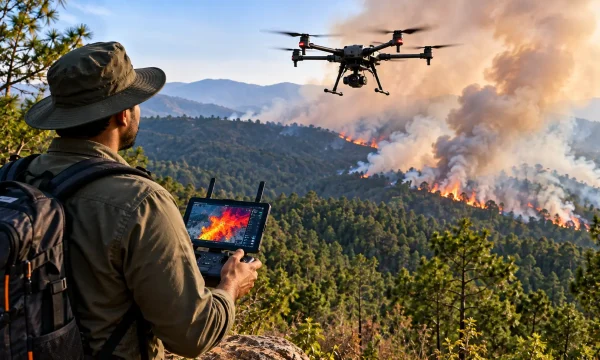
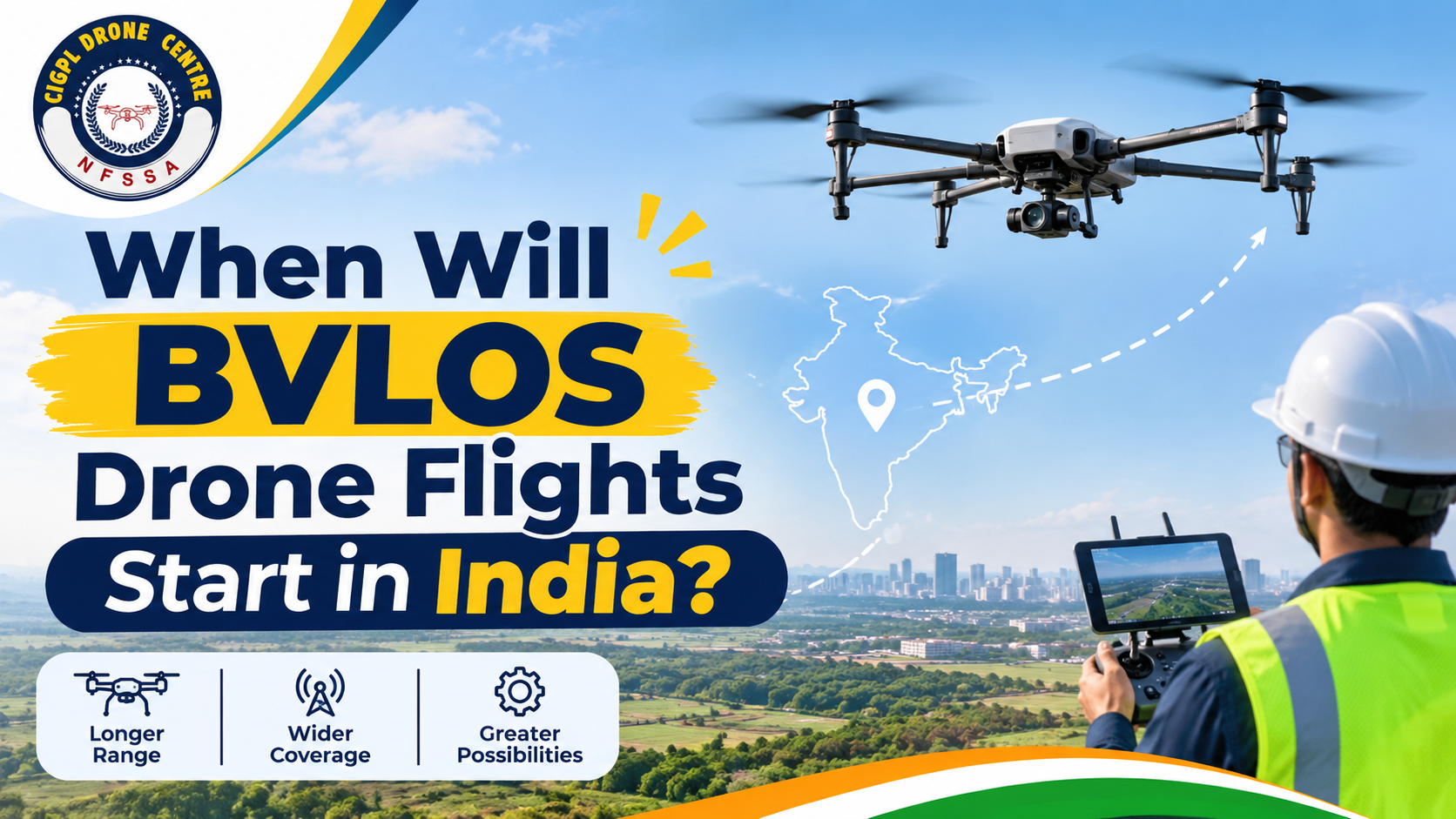
BVLOS, or Beyond Visual Line of Sight, removes that limit. The pilot can no longer see the drone and flies it using a live video feed, telemetry, GPS, onboard sensors and a traffic management system that tracks other aircraft in the area.
The difference sounds small. In practice it changes everything:
Range. A VLOS flight usually covers a few hundred metres. A BVLOS flight can cover tens of kilometres in one go.
Cost. One BVLOS mission can replace many short flights, cutting the time and manpower needed to survey a highway, a power line or a large farm.
Reach. Hill districts, forest areas and remote villages become reachable without a vehicle and a pilot travelling alongside the drone.
This is why industry bodies have pushed for a clear BVLOS framework for years. Without one, drones stay useful but limited.
Where BVLOS Stands in India Right Now
BVLOS is not new to India. It has simply never been routine.
2019 to 2021: the experiments begin. DGCA issued an Expression of Interest notice in May 2019, and the government set up the BVLOS Experiment Assessment and Monitoring (BEAM) Committee. In May 2021 it picked 20 consortia from 34 applications to run experimental BVLOS flights.
2021: the rules open up. Drone Rules 2021 replaced the earlier permission-heavy regime, and later that year the Ministry of Civil Aviation notified a traffic management (UTM) policy framework, widely seen as the first step towards BVLOS.
2021 to 2026: trials, case by case. BVLOS has run only under specific, time-bound exemptions from the Ministry of Civil Aviation and DGCA. DGCA has told Parliament it set up a working group to prepare a regulatory framework for BVLOS.
August 2026: the target is set. At the AP Drone Industry CEO’s Round Table at Orvakal Drone City, Naidu said: “By the end of this year, we will have a refined certification framework with enablement of BVLOS certification.” An inter-departmental committee of MoCA, DGCA and the Quality Council of India is also being formed to work on testing, certification, sandbox facilities and airspace permissions.
At the time of writing, the final framework has not yet been published. When it is, it will appear on DGCA’s official channels, so that is the place to check rather than social media claims.
The Trials That Proved It Works
India already has years of BVLOS experience, mostly in healthcare and logistics.
20 experimental consortia (2021). The BEAM Committee’s 20 selected consortia included drone makers, delivery platforms and logistics firms, all flying under a one-year conditional exemption.
Vaccine delivery in Telangana (2021). MoCA and DGCA granted the Government of Telangana a conditional exemption for experimental BVLOS flights to deliver vaccines, capped at 400 feet with a 15% energy reserve.
Hills and islands (2021). ICMR received permission for experimental BVLOS vaccine delivery in the Andaman and Nicobar Islands, Manipur and Nagaland, at heights up to 3,000 metres.
What these trials asked of pilots. The Telangana conditions required every remote pilot to hold a valid training certificate, have sufficient flying experience and a safe VLOS record. In other words, the government’s own BVLOS trials were built on certified, experienced VLOS pilots.
Which Sectors Will Benefit First
When the minister spoke in August, he said BVLOS is expected to unlock large-scale use across logistics, healthcare, infrastructure and agriculture. Here is how that plays out on the ground.
| Sector | What BVLOS Unlocks | Skills Employers Will Want |
|---|---|---|
| Logistics and healthcare delivery | Medicines, samples and parcels over 10 to 20 km routes | Route planning, emergency procedures, UTM use |
| Infrastructure inspection | Long stretches of power lines, pipelines, rail and highways in one mission | Inspection workflows, thermal and camera payloads |
| Mapping and surveying | Large-area mapping without repeated take-offs | Aerial mapping training, data processing |
| Surveillance and security | Border, forest and coastal patrols over long distances | Drone surveillance training, night operations |
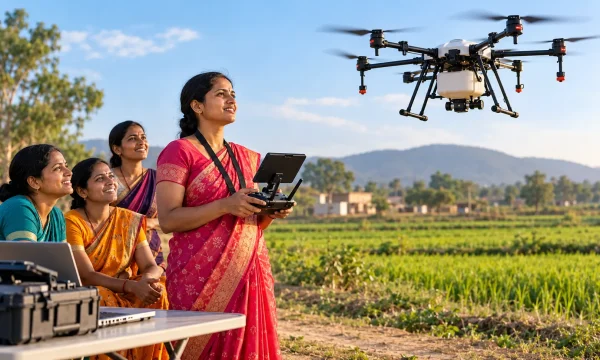
| Agriculture | Large farm clusters covered in fewer flights | Spraying operations, flight planning |
What Pilots Will Actually Need
The final rules are still awaited, but DGCA has already shown the direction. Its training syllabus, issued in February 2022, defines two levels of remote pilot certificate: Category 1 for VLOS and Category 2 for BVLOS.
| Point | Category 1 (VLOS) | Category 2 (BVLOS) |
|---|---|---|
| Where you can fly | Within sight, below 400 ft | Beyond sight, below and above 400 ft, all zones, day and night |
| Training length | About 5 to 8 days | About 150 hours |
| Extra subjects | Basic modules | Air law, airspace, ATC, meteorology, instrument flying, emergency procedures |
| Extra flying | Basic simulator and practical flying | Instrument-flying simulator, detect-and-avoid, night flying |
In other words, BVLOS is not an add-on you pick up in an afternoon. It is a higher level of DGCA drone pilot certification, built on top of the basics.
Three things will matter most:
A solid foundation first. The syllabus allows credit for pilots who already hold a Category 1 certificate. That makes the standard rpc drone license the natural first step, not something to skip.
Comfort with instruments and systems. BVLOS pilots fly by screens, telemetry and traffic data. Pilots who already understand payloads, flight planning and ground control software will adapt faster.
A specialisation. Most early BVLOS work will be in delivery, inspection, mapping and patrols. Pilots with drone surveillance training or aerial mapping training will have a clear advantage when operators start hiring for BVLOS missions.
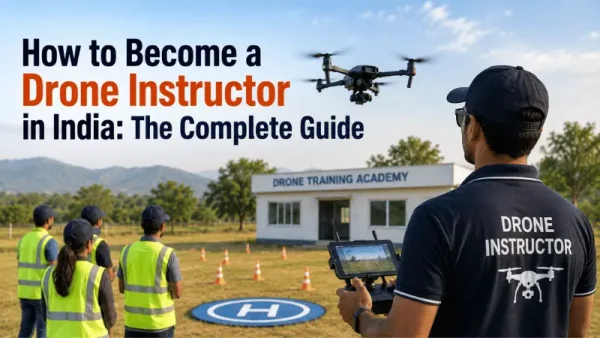
Training quality matters more than ever here. Choose a DGCA approved drone training institute that follows DGCA’s syllabus closely, has proper simulators and instructors, and teaches flight planning and payload work alongside basic flying.
FAQs
Is BVLOS flying legal in India right now?
Only with specific approval from the government and DGCA. Routine BVLOS operations will depend on the new certification framework the government has targeted for the end of 2026.
Does my current remote pilot certificate allow BVLOS flights?
No. A standard certificate covers VLOS flying only. DGCA’s syllabus treats BVLOS as a separate, higher category with much longer training.
Should I wait for BVLOS rules before getting trained?
No. BVLOS training builds on the basic certificate, and DGCA’s syllabus gives credit to pilots who already hold one. Getting certified now puts you a step ahead.
Which jobs will need BVLOS pilots first?
Delivery, long-distance inspection, large-area mapping and security patrols are expected to move first, as these gain the most from longer range.
Will BVLOS make drone pilots less important because drones fly themselves?
No. BVLOS flights still need trained pilots to plan missions, monitor systems and handle emergencies. The skill level goes up, not down.
Summary
BVLOS is the change that takes Indian drones from short, site-based jobs to long-range missions across districts. The government has set the end of 2026 as its target for a BVLOS certification framework, and DGCA’s syllabus already shows that BVLOS pilots will need far deeper training than today’s basic course.
The pilots who benefit first will be the ones who already hold a solid certificate and have specialised skills to build on. Start with the Remote Pilot Certificate course at CIGPL, then go further with the Surveillance & Mapping Drone Course in India to be ready when BVLOS work opens up in 2027.
Sources
- PIB: Exemption to conduct BVLOS experimental flights, 20 entities granted permission (May 2021)
- PIB: Telangana Government granted exemption for BVLOS experimental flights (May 2021)
- PIB: MoCA grants drone use permission to ICMR and IIT Bombay (September 2021)
- Ministry of Civil Aviation: National UTM Policy Framework (October 2021)
- DGCA: Drone Training Circular 02 of 2022, syllabus for remote pilots
- Rajya Sabha: reply on BVLOS regulatory framework (December 2024)
- PIB: India’s Drone Ecosystem, from policy to public service (February 2026)