Namo Drone Didi: How a Government Scheme Is Putting Drones in the Hands of Rural Women
Quick Summary
- Launched on November 30, 2023, the Namo Drone Didi scheme aims to provide 15,000 agricultural drones to women-led Self Help Groups across India, backed by a Rs. 1,261 crore budget.
- Each SHG receives up to 80 percent subsidy on the drone package, with the remaining 20 percent financed through a government-backed loan at just 3 percent interest annually.
- Women who complete the programme are earning Rs. 60,000 to Rs. 80,000 per month during peak agricultural seasons, far exceeding the scheme’s minimum target of Rs. 1 lakh per year.
- The scheme is not just about drones. It is about repositioning rural women from being labourers in agriculture to being certified pilots and technology entrepreneurs who own their own service businesses.
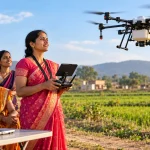
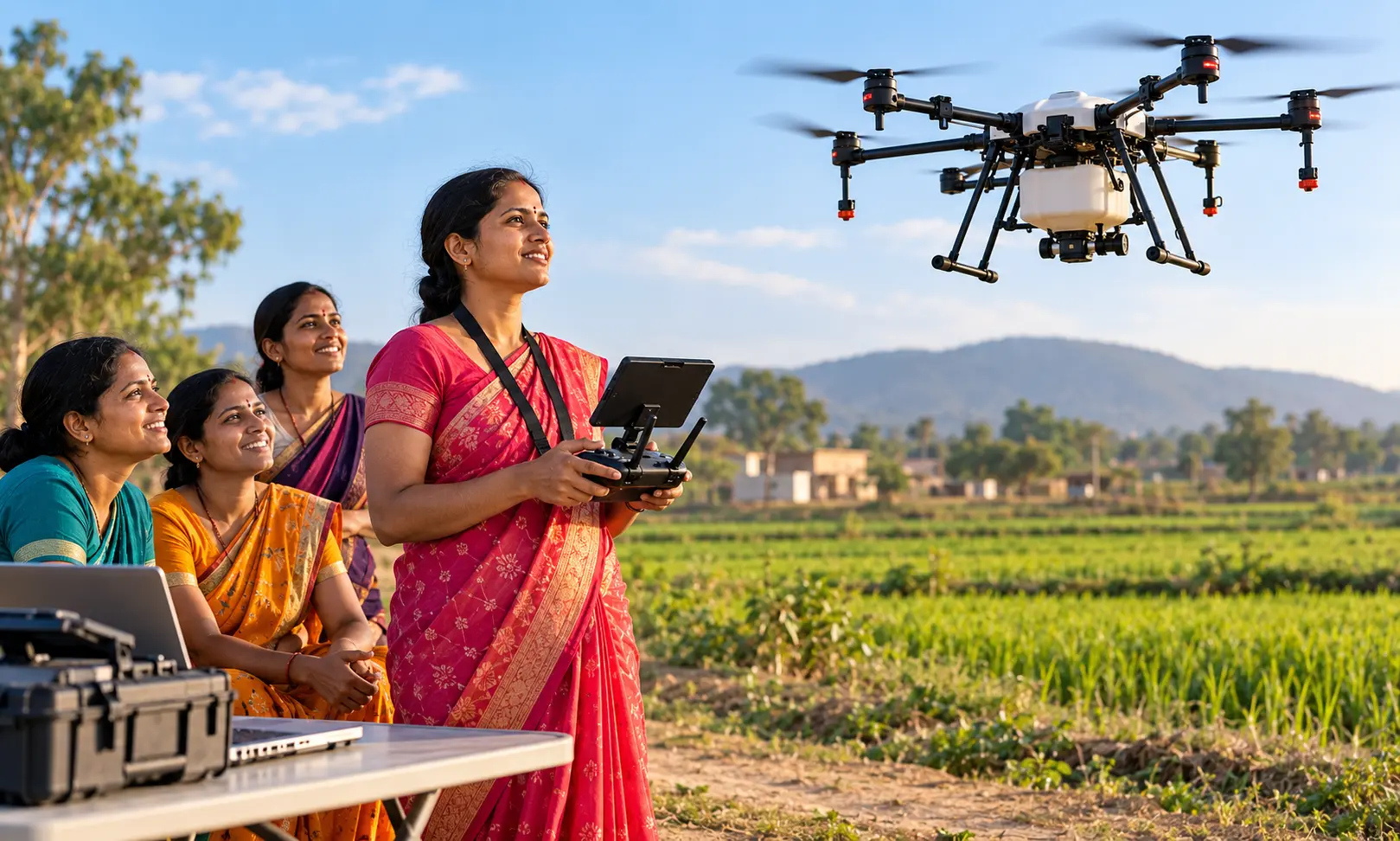
Somewhere in a paddy field in Karnataka, a woman who spent years doing manual agricultural work is now a DGCA-certified drone pilot. She operates a machine worth over Rs. 14 lakhs, serves dozens of farmers in her village, and earns more in a single peak season month than most people in her community earn in a year.
Her name is not in any newspaper. But she is one of over a thousand women across India who have already made this transition under the Namo Drone Didi scheme.
This is the story of how one government programme is changing what a rural woman’s working life can look like.
What the Scheme Is and How It Works
Prime Minister Narendra Modi launched the Namo Drone Didi scheme on November 30, 2023. It operates under the Department of Agriculture and Farmers Welfare, in partnership with the Deendayal Antyodaya Yojana National Rural Livelihoods Mission (DAY-NRLM).
The objective is straightforward: equip 15,000 Women Self Help Groups with agricultural drones and train them to run drone spraying service businesses for local farmers.
The financial structure is designed to remove the most obvious barrier: cost. A full agricultural drone package, including the aircraft, four spare battery sets, a fast charger, field generator, and one year of insurance, costs between Rs. 14 and Rs. 15 lakhs in the real market.
The government covers 80 percent of this cost through a Central Financial Assistance grant, capped at Rs. 8 lakhs per SHG. The remaining 20 percent is financed through the Agriculture Infrastructure Fund at a 3 percent annual interest rate. Any gap between the Rs. 8 lakh cap and the actual package cost is covered by Lead Fertilizer Companies such as IFFCO, Coromandel, and KRIBHCO through CSR funds. These companies benefit because Drone Didis become local distribution networks for liquid nano-fertilisers.
The result: the SHG acquires a Rs. 14 lakh piece of equipment for a very manageable monthly loan repayment.
The Training: From Village to Certified Pilot in 15 Days
The scheme does not just hand over a drone. It funds a full 15-day training programme that turns an SHG member into a legally certified commercial drone pilot.
The first five days are conducted at a DGCA-approved RPTO. The trainee covers aviation theory, airspace regulations, flight simulation, and safety protocols. At the end of this module, she receives her Remote Pilot Certificate, making her a licensed commercial drone operator.
The next ten days shift to agricultural applications: chemical mixing, safe payload handling, spray calibration, and managing different crop canopies.
A second SHG member simultaneously completes a five-day Drone Assistant course covering battery management, equipment transport, field repairs, and chemical preparation. This two-person team structure is what makes daily operations efficient. While the pilot flies, the assistant swaps batteries, refills payload tanks, and manages ground logistics. Together, they can cover 20 to 25 acres per day without significant downtime.
What Women Are Actually Earning
The scheme sets a minimum annual income target of Rs. 1 lakh per SHG. The reality, for many active operators, is considerably better.
At the standard rate of Rs. 300 to Rs. 400 per acre, covering 20 to 25 acres per day generates Rs. 8,000 to Rs. 12,000 in gross daily revenue during peak season. Across a peak agricultural window, this translates to Rs. 60,000 to Rs. 80,000 per month for active operators.
Real case data from across India confirms this:
Shabina, Ayodhya, Uttar Pradesh: Charging Rs. 400 per acre and combining drone services with her existing polyhouse farming operation, Shabina grew her gross annual income from Rs. 2.5 lakhs to Rs. 8 to 10 lakhs. Net income reached Rs. 5.5 to 6.5 lakhs, a fourfold increase.
Kiran Ahirwar, Guna, Madhya Pradesh: Even during off-peak periods, Kiran earns Rs. 12,000 to Rs. 15,000 monthly by combining drone crop monitoring, soil analysis, and vermicomposting.
These are not exceptional cases. They reflect what the model delivers when run with consistent effort.
What Women Are Actually Earning
The scheme sets a minimum annual income target of Rs. 1 lakh per SHG. The reality, for many active operators, is considerably better.
At the standard rate of Rs. 300 to Rs. 400 per acre, covering 20 to 25 acres per day generates Rs. 8,000 to Rs. 12,000 in gross daily revenue during peak season. Across a peak agricultural window, this translates to Rs. 60,000 to Rs. 80,000 per month for active operators.
Real case data from across India confirms this:
Shabina, Ayodhya, Uttar Pradesh: Charging Rs. 400 per acre and combining drone services with her existing polyhouse farming operation, Shabina grew her gross annual income from Rs. 2.5 lakhs to Rs. 8 to 10 lakhs. Net income reached Rs. 5.5 to 6.5 lakhs, a fourfold increase.
Kiran Ahirwar, Guna, Madhya Pradesh: Even during off-peak periods, Kiran earns Rs. 12,000 to Rs. 15,000 monthly by combining drone crop monitoring, soil analysis, and vermicomposting.
These are not exceptional cases. They reflect what the model delivers when run with consistent effort.
Where the Scheme Stands in 2026
As of early 2026, Lead Fertilizer Companies have distributed 1,094 drones across 22 states. Karnataka leads with 145 drones, followed by Uttar Pradesh (128), Andhra Pradesh (108), and Haryana (102).
| State | Drones Distributed |
|---|---|
| Karnataka | 145 |
| Uttar Pradesh | 128 |
| Andhra Pradesh | 108 |
| Haryana | 102 |
| Madhya Pradesh | 89 |
| Telangana | 81 |
| Maharashtra | 60 |
| Gujarat | 58 |
| Punjab | 57 |
The remaining balance of the 14,500 targeted drones has been allocated to state governments and is being rolled out through the 2025-26 financial year.
The Challenges and How They Are Being Addressed
No scheme this ambitious runs without friction.
Transport: A government-commissioned study by the Agricultural Development and Rural Transformation Centre in Bangalore found that 42.68 percent of Drone Didis faced severe problems transporting equipment to farms. In Southern India, this figure was 78.82 percent. In response, the government activated a provision under the Sub-Mission on Agricultural Mechanisation providing an 80 percent subsidy for SHGs to purchase utility vehicles like electric rickshaws specifically for drone transport.
Seasonal income: Agricultural spraying demand peaks during two windows, Kharif and Rabi, and drops off in between. To address this, the scheme trains pilots to offer off-season services including crop health monitoring, soil analysis, and irrigation leak detection, effectively turning a seasonal spraying business into a year-round agricultural consultancy.
Social barriers: When the scheme first launched, male farmers in many villages were sceptical that women could handle expensive aviation equipment. As pilots repeatedly delivered flawless spraying operations and demonstrably improved crop yields, the scepticism shifted to reliance. The recognition that followed has been one of the most significant community-level outcomes of the programme.
The Lakhpati Didi Connection
The Namo Drone Didi scheme sits within the broader Lakhpati Didi mission, which targets an annual household income of Rs. 1 lakh or more for 3 crore rural women. Most traditional SHG micro-enterprises, such as tailoring or artisanal crafts, struggle to reach this threshold because local markets are small.
The drone service model is different. It gives an SHG a local technological advantage that cannot be easily replicated, strong demand from farmers who want their inputs applied efficiently, and pricing power that manual sprayers cannot match. For many SHGs, this is the fastest route to Lakhpati Didi status they have ever had access to.
FAQs
Women who are active, registered members of a Self Help Group under the DAY-NRLM network. The SHG is the unit of application, not an individual.
No. The entire 15-day training programme is built from the ground up for participants with no prior aviation or technology background.
The scheme package includes a two-year annual maintenance contract and one year of insurance. Beyond the initial coverage, the Drone Assistant's training in minor repairs is specifically designed to handle common field-level hardware issues without expensive service calls.
Yes, and it is actively encouraged. Crop health monitoring, soil analysis, yield estimation, and irrigation assessment are all services that the same drone can deliver, providing year-round revenue streams.
The initial rollout covered 22 states. The full deployment of 14,500 drones across all participating states is ongoing through the 2025-26 financial year.
Summary
The Namo Drone Didi scheme is one of the most practically designed rural development programmes India has launched in years. It does not give women a tool and walk away. It gives them the capital, the training, the certification, and the market to build a real business around it.
The results speak clearly: women earning Rs. 60,000 to Rs. 80,000 per month during peak season, incomes multiplying fourfold, and communities that once doubted their ability now depending on their expertise.
For anyone interested in the broader landscape of drone careers and opportunities in India, take a look at our drone training programmes at CIGPL to understand how DGCA certification works and what doors it opens across sectors.