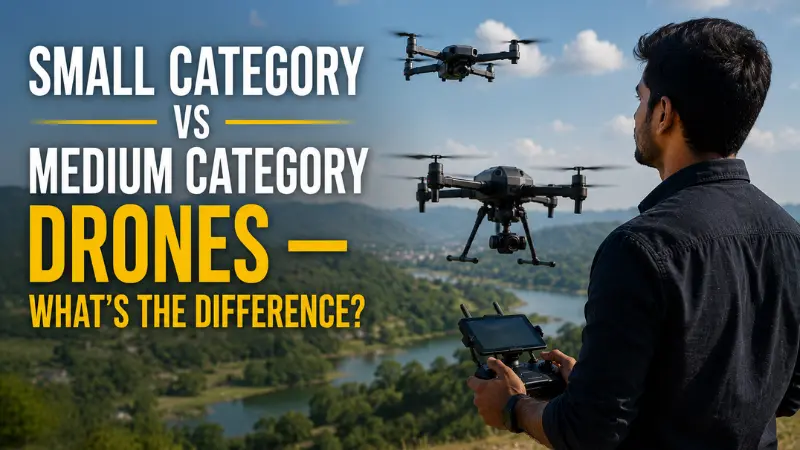
Small Category vs Medium Category Drones – What’s the Difference?
Quick Summary
- Under India’s Drone Rules 2021, Small category drones weigh between 2 kg and 25 kg, while Medium category drones weigh between 25 kg and 150 kg. The classification is based on Maximum All-Up Weight, meaning the drone’s total weight in flight including payload and batteries.
- Both categories require a Type Certificate, UIN registration, Remote Pilot Certificate, and third-party insurance, but the RPC for each category is different and must match the drone you are flying.
- Small drones dominate surveying, inspection, and media work. Medium drones are primarily used for agricultural spraying and heavy-lift logistics.
- A pilot can upgrade from Small to Medium certification in just 2 to 3 days without repeating the full course, costing around Rs. 30,000.
If you are getting into commercial drone operations in India, one of the first practical questions you will face is this: does it matter which category of drone you train on?
The short answer is yes, it matters quite a bit. The category of drone you are certified to fly determines what jobs you can legally take, what regulatory requirements you need to meet, and in many cases what you can earn.
India’s Drone Rules 2021 classify all drones into five categories based on weight. The two most commercially relevant categories for working professionals are Small and Medium. They are different in ways that go well beyond just weight, and choosing which one to train on is a decision worth understanding properly before you commit.
This article covers everything you need to know: the legal definitions, the regulatory differences, what each category is actually used for, how the training works, and what the career and salary implications are.
The Legal Definitions: What Makes a Drone Small or Medium?
Under the Drone Rules 2021, classification is based entirely on Maximum All-Up Weight (MAUW). This is not the empty weight of the drone. It is the total weight of the drone at the moment of takeoff in its heaviest approved operating configuration, including the airframe, the heaviest battery variant, all propellers and communication modules, and the maximum payload the system is designed to carry.
A Small category drone weighs more than 2 kg but no more than 25 kg (MAUW).
A Medium category drone weighs more than 25 kg but no more than 150 kg (MAUW).
The MAUW rule catches a lot of operators off guard. An agricultural spraying drone might have an empty airframe weight of 14 kg, which looks like it falls into the Small category. But once you add a full liquid chemical tank of 10 kg and the operational batteries, the total weight crosses 25 kg. That makes it a Medium category drone legally, regardless of what the marketing materials say. Flying it with a Small category certificate is a compliance violation that immediately voids your insurance.
Regulatory Requirements: What Both Categories Share
Both Small and Medium drones require the same foundational compliance framework under the Drone Rules 2021.
Type Certificate: Before any drone model can be legally sold or operated in India, it must be Type Certified by the DGCA through testing by the Quality Council of India or an authorized testing entity. The testing covers structural integrity, electromagnetic compatibility, failsafe mechanisms, and No Permission No Takeoff compliance.
Unique Identification Number (UIN): Every individual drone unit must be registered on the Digital Sky Platform via Form D-2 to receive a UIN. The fee is Rs. 100. The UIN must be physically affixed to the drone before any flight.
Remote Pilot Certificate: Any commercial use of a Small or Medium drone requires the pilot to hold a valid RPC. Recreational use also requires an RPC for these categories.
Third-Party Liability Insurance: Insurance is mandatory for all Small and Medium drone operations, covering potential damage to life or property during flight.
Airspace compliance: Both categories are subject to the same Green, Yellow, and Red zone restrictions on the Digital Sky Platform. Green Zone operations up to 120 metres above ground level do not require prior permission. Yellow Zone operations near airports require ATC clearance. Red Zone operations are prohibited unless the Central Government grants specific permission.
Where the Two Categories Diverge
The key regulatory difference is the RPC itself. A Small category RPC is not valid for flying a Medium category drone. You need the correct certificate for the weight class of the drone you are operating.
The Medium category RPC requires additional specialized training focused on handling heavier inertia, complex payload dynamics, and the advanced risk assessment that comes with operating aircraft that can carry 40 litres of liquid chemicals or heavy cargo at low altitude over populated farmland.
Medium agricultural drones also intersect with frameworks beyond civil aviation. Operators spraying pesticides and agrochemicals must comply with standard operating procedures set by the Ministry of Agriculture and Farmers Welfare and the Central Insecticides Board and Registration Committee, covering chemical handling, dilution ratios, and spray parameters.
Real-World Use Cases: What Each Category Is Actually Used For
Small Category Drones
Small drones are the workhorses of precision data collection. Their payload capacity tops out at around 3 to 5 kg, which is ideal for carrying sensitive, lightweight electronic sensors rather than heavy cargo.
The primary uses in India include:
Surveying and mapping: Small drones equipped with high-resolution cameras, RTK modules, and LiDAR sensors produce centimetre-accurate orthomosaic maps and 3D terrain models for highway projects, urban planning, and mining compliance. The SVAMITVA scheme uses fleets of Small category drones to map rural villages across India.
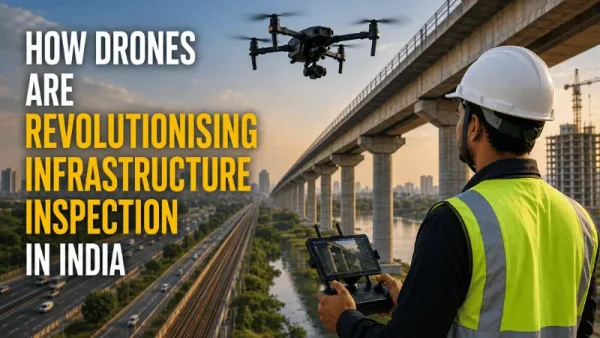
Infrastructure inspection: Power lines, solar farms, wind turbines, telecom towers, and bridges are routinely inspected using Small drones equipped with thermal and zoom cameras. Their agility allows precise flight in complex spatial environments without putting inspectors at risk.
Surveillance and security: Platforms like the ideaForge Q6 V2 with thermal electro-optical infrared payloads are used for border monitoring, tactical police surveillance, and anti-poaching operations.
Media and cinematography: Film productions, real estate marketing, and event coverage use Small category drones with high-quality camera gimbals for professional aerial footage.
Medium Category Drones
Medium drones are built for heavy-lift industrial applications where the primary job is physical delivery or mechanical actuation rather than data collection.
The dominant use in India is agricultural spraying. Medium drones carry 10 to 40 litre liquid tanks and deliver precise doses of pesticides, fertilisers, and nano-nutrients across farmland. A single Medium drone covers up to 50 acres per day, using 90% less water and 30 to 40% fewer chemicals than manual spraying.
Beyond agriculture, Medium drones are increasingly used for:
Seed and granular broadcasting: Spreading solid fertilisers, seeds, and fish feed in aquaculture ponds. Particularly useful in flooded paddy fields where manual transplantation is physically demanding.
Last-mile logistics: Trial BVLOS delivery programmes for medical supplies and e-commerce packages in hard-to-reach areas. Companies like Skye Air and Airbound are building out these networks.
Disaster management: Heavy payload drops in inaccessible terrains during flood or earthquake response.
Physical and Technical Differences
The engineering of Small and Medium drones reflects their completely different jobs.
| Feature | Small Category | Medium Category |
|---|---|---|
| Typical payload capacity | 3 to 5 kg (sensors) | 10 to 40 kg (liquid/cargo) |
| Flight time (fully loaded) | 40 to 72 minutes | 7 to 25 minutes |
| Airframe material | Aerospace-grade carbon fibre, foldable | Heavy composite, rugged industrial build |
| Motor type | High-efficiency brushless, smaller propellers | High-torque, low-KV motors, 23 to 50 inch propellers |
| Battery capacity | Standard LiPo, charged via wall adapter | 20,000 to 30,000 mAh, requires field generators |
| Charging time (field) | 30 to 60 minutes | 10 minutes (requires 3-phase generator) |
| Obstacle avoidance | Vision and ultrasonic sensors | Active phased array radar, terrain-following |
| Portability | Backpack-sized, single person | Heavy, requires vehicle transport |
The flight time difference is significant. Small drones achieve 40 to 72 minutes per battery because they are optimised for efficiency. Medium drones drain their massive batteries in 7 to 25 minutes because keeping 50 to 90 kg airborne demands enormous power. Continuous agricultural operations require rotating through 4 to 6 battery packs with a field generator, which is a substantial logistical operation.
Popular Models and Prices in India (2026)
| Category | Model | Primary Use | Price Range (Rs.) |
|---|---|---|---|
| Small | DJI Matrice 350 RTK | Survey and inspection | 7.0 to 12.0 lakh |
| Small | ideaForge Q6 V2 | Tactical surveillance, mapping | Enterprise pricing (B2B) |
| Small | Garuda Kisan 8L | Light agricultural spraying | 4.5 to 5.5 lakh |
| Medium | IoTechWorld Agribot A6 | 10-litre agricultural spraying | 3.5 to 5.0 lakh |
| Medium | Marut AG365 | 11-litre multi-utility agricultural | 9.89 to 10.0 lakh |
| Medium | DJI Agras T40 | 40-litre spray, coaxial twin-rotor | 15.65 to 18.0 lakh |
| Medium | DJI Agras T50 | 40-litre spray or 50 kg spread | 15.0 lakh+ |
One important note: DJI products are excluded from government subsidy schemes due to India’s Make in India policy, though they remain available for private purchase. Subsidies apply to DGCA Type Certified domestic manufacturers like Garuda Aerospace, Marut Drones, and IoTechWorld.
Training: What Each Certificate Requires
Both categories are trained at DGCA-approved RPTOs. The structure is similar but the content differs.
Small category RPC (5 to 7 days): Ground theory covering aviation meteorology, airspace rules, aerodynamics, ATC procedures, and risk assessment. Simulator sessions. Live flight training on Small category drones. Written exam and practical skill test.
Cost: Rs. 18,000 to Rs. 55,000 depending on the institute and location.
Medium category RPC (5 to 7 days): Same foundational aviation theory but with additional modules on heavy-lift aerodynamics, payload management under shifting weight conditions (like a draining liquid tank), and emergency handling specific to large agricultural or cargo drones. Live flight training on Medium category drones.
Cost: Rs. 40,000 to Rs. 80,000 as a standalone course.
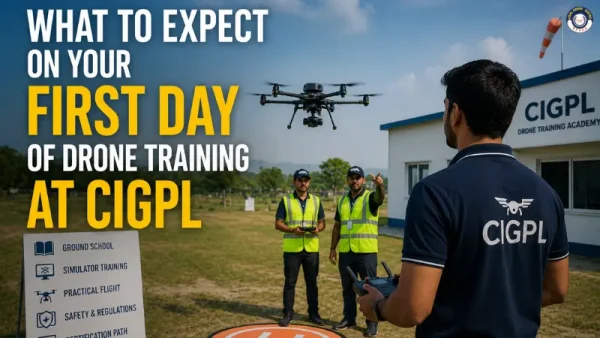
Combined Small and Medium certification (7 to 8 days): Many institutes including CIGPL offer combined programmes where both certifications are completed together in an integrated schedule. This is the most efficient route for anyone planning to work across both categories.
Cost: approximately Rs. 65,000.
Upgrade from Small to Medium (2 to 3 days): If you already hold a valid Small category RPC, you do not need to repeat the full course to add Medium certification. A dedicated upgrade track focuses exclusively on the advanced theory and practical flight hours specific to Medium drones.
Cost: approximately Rs. 30,000.
All RPCs remain valid for 10 years from the date of issue.
Career and Salary: Does Category Matter?
Yes, but perhaps not in the way most people expect. The weight category is less important than the sector you work in and what data skills you bring to the job.
| Role and Category | Experience Level | Monthly Salary (Rs.) | Annual (LPA) |
|---|---|---|---|
| General operations (any category) | Fresher | 25,000 to 45,000 | 3.0 to 5.5 |
| Agricultural spraying (Medium) | Junior | 25,000 to 50,000 | 3.0 to 6.0 |
| Agricultural spraying (Medium) | Mid-level | 50,000 to 1,00,000 | 6.0 to 12.0 |
| Survey and GIS mapping (Small) | Mid-level with data skills | 66,000 to 1,50,000 | 8.0 to 18.0 |
| Survey and GIS mapping (Small) | Senior | 1,50,000 to 2,90,000 | 18.0 to 35.0 |
| Infrastructure inspection (Small or Medium) | Mid-level | 1,00,000 to 1,83,000 | 12.0 to 22.0 |
| Infrastructure inspection (Small or Medium) | Senior | 1,83,000 to 3,33,000 | 22.0 to 40.0 |
| Defence and tactical operations | Senior | 2,50,000 to 5,00,000 | 30.0 to 60.0 |
The pattern is clear. Medium agricultural pilots earn well, especially those running their own Drone-as-a-Service businesses who can net Rs. 15 to 40 lakhs annually. But the highest corporate salaries go to Small category pilots who have added GIS, photogrammetry, and data processing skills on top of their flying ability. In the Small drone world, the data is worth more than the flight.
Government Schemes for Each Category
For Medium category drones (agricultural):
The Namo Drone Didi scheme provides an 80% subsidy (capped at Rs. 8 lakhs) specifically for women-led Self Help Groups purchasing Medium agricultural drones. The package includes the drone, batteries, charger, insurance, and training. As of early 2026, over 1,094 drones have been distributed.
The Sub-Mission on Agricultural Mechanization (SMAM) provides 40 to 50% subsidies for individual farmers and Custom Hiring Centres, and up to 75% for Farmer Producer Organisations. SC/ST farmers, women, and small and marginal landholders get the higher 50% rate.
The Agriculture Infrastructure Fund covers remaining costs through collateral-free loans with a 3% interest subvention.
For Small category drones (surveying):
The SVAMITVA scheme is the largest government driver of Small drone deployment in India. The Survey of India uses Small category surveying drones to map over 3.44 lakh villages and issue property cards to rural households. This programme creates sustained demand for trained Small category mapping pilots with RTK/PPK skills.
Penalties: Are They Different by Category?
The administrative fine structure under Rule 50 of the Drone Rules 2021 is the same for both categories, with a maximum compoundable fine of Rs. 1,00,000 per violation.
However, the real-world consequences of a violation scale with the weight of the drone. A fully loaded 90 kg Medium drone crashing over a populated area presents a vastly higher civil liability exposure than a 5 kg Small drone. Insurance coverage becomes even more critical for Medium category operators for this reason.
Violations involving Red Zone airspace breaches are non-compoundable criminal offences for both categories, potentially leading to confiscation and imprisonment. The DGCA can also suspend or permanently cancel both the drone registration and the pilot certificate.
Which Should You Train On?
Choose Small category if: You want to work in surveying and GIS mapping, infrastructure inspection, surveillance, or media production. You plan to add data processing skills to move into higher-paying analytical roles. You want a highly portable setup that one person can carry and deploy independently.
Choose Medium category if: You want to work in agricultural spraying and run your own drone service business in a rural area. You want to operate under government subsidy schemes like SMAM or Namo Drone Didi. You are targeting the agri-tech sector where consistent seasonal income is the goal.
Choose both if: You want maximum career flexibility. A combined programme at CIGPL covers both categories in a single training period, so you are not locked into one sector. You can see the full range of our drone training courses and how we structure the combined certification pathway.
If you already hold a Small category RPC and want to add Medium, the upgrade takes just 2 to 3 days. And if you want to move beyond flying into data analysis and mapping, our Surveillance and Mapping Drone Course is the logical next step after your Remote Pilot Certificate.
FAQs
MAUW is the total weight of the drone at the moment of flight, including the airframe, heaviest battery, and maximum payload. A drone marketed as a 14 kg machine can become a Medium category drone once you add a full liquid tank and batteries. Classification is based on this loaded weight, not the empty airframe. Getting this wrong voids your insurance and creates a compliance violation.
It is a Medium category drone. 20 kg empty plus 10 kg of liquid plus operational batteries exceeds the 25 kg threshold. You need a Medium category RPC to fly it commercially, regardless of the drone's marketing category.
No. An RPC authorises you to fly that category of drone but does not override airspace restrictions. You must still check the Digital Sky Platform before every flight and comply with Green, Yellow, and Red zone rules.
Yes. A Fast Track Upgrade from Small to Medium takes 2 to 3 days and costs around Rs. 30,000. You do not repeat foundation theory, only the Medium-specific payload management and live flight sessions.
A basic fitness certificate from any registered MBBS doctor or a DGCA-authorised Class 2 Aviation Medical Examiner. You do not need the stringent Class 1 aviation medical required for commercial airline pilots.
Medium agricultural drones qualify for SMAM subsidies (40 to 80% depending on applicant type) and the Namo Drone Didi scheme. Small drones are used in government programmes like SVAMITVA but do not carry direct purchase subsidies for individuals.
Not automatically. Agricultural spraying pilots on Medium drones earn well, particularly as independent operators. But the highest corporate salaries in the drone industry go to Small category pilots who have added data analysis and GIS skills. Category alone is less important than what you do with the data.
Summary
The Small versus Medium category distinction in India’s drone regulations is not just a matter of size. It shapes what you can legally fly, what jobs you can take, what training you need, and how your career can develop.
Small drones are built for precision data collection and thrive in surveying, inspection, and surveillance work. The salary ceiling for Small category pilots who add data skills is among the highest in the industry. Medium drones are built for heavy-lift industrial applications, with agricultural spraying being the dominant use case, supported by substantial government subsidy programmes.
Both categories require the same foundational compliance framework: Type Certificate, UIN, RPC, and insurance. The RPC itself must match the category you are flying, though upgrading from Small to Medium is straightforward once you hold the initial certificate.
If you are ready to get started or want to understand how CIGPL structures training across both categories, visit our drone training page for the full picture.