Top 7 Career Options After Getting Your DGCA Drone Pilot Certificate in India
Quick Summary
- India has nearly 40,000 certified drone pilots but needs over 1,00,000 to meet current industry demand, which means certified pilots have real leverage in the job market right now.
- Career options span agriculture, surveying, infrastructure inspection, media, logistics, defence, and training, each with distinct salary bands and growth trajectories.
- Pilots who add data skills like photogrammetry, LiDAR, or thermal imaging to their RPC earn 15 to 35 percent more than those who only know how to fly.
- The drone industry in India is growing at over 21% annually and is expected to support over 6,00,000 service-sector jobs in the coming years.
A lot of people who sign up for drone training have one question: what do I do with this certificate once I have it?
It is a fair thing to wonder. The Remote Pilot Certificate takes less than two weeks to get. The DGCA syllabus is clear, the training is structured, and the exam is straightforward. But once you land at the other side with a certificate in hand, the career landscape can feel wide open in a way that is both exciting and a little overwhelming.
The good news is that the Indian drone industry in 2026 is not short of opportunities. It is short of skilled, certified pilots. As of early 2026, India has just under 40,000 DGCA-certified remote pilots, but industry estimates suggest the sector needs over 1,00,000 certified professionals to meet current demand. That gap means faster hiring, better salaries, and more room to grow than in most other fields.
This article walks you through seven of the strongest career paths open to you after getting your DGCA drone pilot certificate, with honest information on what the work actually involves, what it pays, and where the growth is headed.
The State of the Drone Job Market in India (2026)
Before getting into the specific careers, it helps to understand the size of the opportunity.
The Indian drone market generated over USD 1.2 billion in revenue in 2025 and is projected to reach USD 3.2 billion by 2030, growing at a compound annual growth rate of over 21%. That is nearly three times the global average growth rate for the drone industry.
Government policy is driving a large part of this growth. The SVAMITVA scheme is mapping over 6.62 lakh villages using drones. The Namo Drone Didi initiative is distributing 15,000 agricultural drones to women-led Self Help Groups. The government is also in the process of executing a USD 2 billion indigenous defence drone procurement. The National Highways Authority of India now mandates monthly drone footage for all highway construction projects. Indian Railways directs all zones to use drones for track and bridge inspection.
Each of these is not a one-time project. They are recurring, multi-year employment pipelines for certified drone pilots.
Best Career Options After Getting Drone Pilot Certificate in India
Career 1: Agricultural Drone Pilot
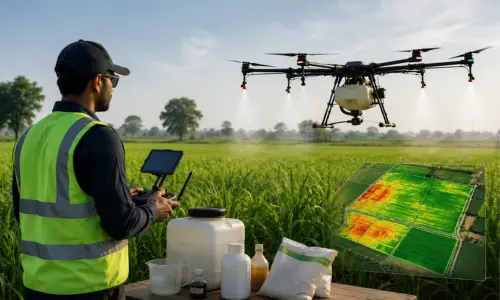
What the job involves: Agricultural drone pilots spray pesticides, liquid nano-fertilizers, and herbicides over farmland using heavy-payload drones. They also fly multispectral sensors that produce NDVI (Normalized Difference Vegetation Index) maps, which help farmers detect crop stress, pest infestations, and water deficiency before any visible damage appears.
A typical work day involves assessing the field, preparing the chemical mix at the right dilution, loading the payload, and running automated grid-flight patterns over the crop. During peak agricultural seasons, a pilot can cover several hundred acres per day.
To put the efficiency into context: manual pesticide spraying for a 50-acre farm costs roughly Rs. 15,000 and takes five days. A drone completes the same job in about four hours for Rs. 3,000.
Who hires: State-backed Krishi Vigyan Kendras, agri-tech startups like Garuda Aerospace and Marut Drones, agri-input chemical companies, farm cooperatives, and women-led Self Help Groups under the Namo Drone Didi scheme.
Salary range: Rs. 30,000 to Rs. 70,000 per month. Annually, junior pilots earn Rs. 3.5 to Rs. 6.0 LPA, mid-level pilots earn Rs. 6.0 to Rs. 12.0 LPA, and senior operators earn Rs. 12.0 to Rs. 20.0 LPA.
Growth outlook: Explosive. This is currently the highest-volume hiring sector in Indian drone operations, and it is still expanding fast.
Career 2: Surveying and Mapping Specialist
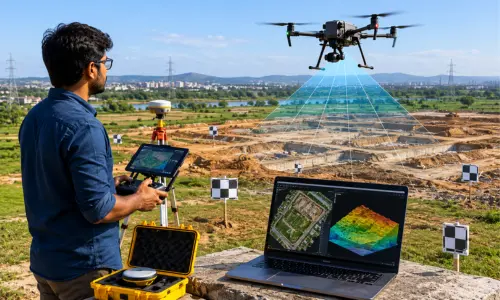
What the job involves: Surveying pilots produce centimetre-accurate land maps for government projects, civil engineering, urban planning, and property demarcation. Before a flight, the pilot places Ground Control Points (physical markers) across the survey area and records their GPS coordinates. The drone then flies a pre-planned grid, capturing thousands of overlapping images.
After the flight, the data is processed through software like Pix4D or Agisoft Metashape to produce orthomosaic maps, Digital Elevation Models, and 3D terrain models. These deliverables are used by planners, engineers, and government bodies to make decisions worth crores of rupees.
This is one of the most intellectually demanding drone careers and also one of the best-paid.
Who hires: Construction developers, mining companies, state land survey departments, geospatial firms, and government bodies running the SVAMITVA scheme. Companies like Matrixgeo, SQUADRONE, and IG Drones actively recruit in this space.
Additional skills needed: Photogrammetry software (Pix4D, Agisoft Metashape, DroneDeploy), GIS tools (ArcGIS, QGIS), and experience with RTK/PPK positioning modules and LiDAR sensors.
Salary range: Entry-level: Rs. 4.0 to Rs. 8.0 LPA. Mid-level with data skills: Rs. 8.0 to Rs. 18.0 LPA. Senior GIS specialists: Rs. 18.0 to Rs. 35.0 LPA.
Growth outlook: High and stable. The SVAMITVA scheme alone has created a multi-year demand pipeline that far exceeds the current supply of qualified pilots.
If surveying and mapping interests you, the Surveillance and Mapping Drone Course at CIGPL is built specifically for pilots who want to work in this field.
Career 3: Infrastructure Inspection Pilot
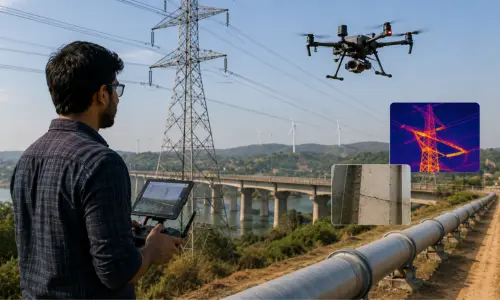
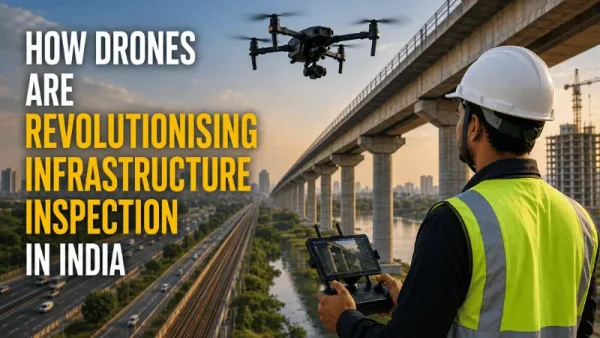
What the job involves: Infrastructure pilots inspect assets that are dangerous or difficult to check manually: high-voltage power lines, oil and gas pipelines, wind turbine blades, bridges, solar farms, and active construction sites. They use thermal cameras to detect heat anomalies in solar panels or electrical faults in substations, and high-resolution cameras to identify micro-cracks in concrete.
Flying near high-voltage lines comes with serious risks. Electromagnetic interference can disrupt navigation systems, which means pilots need to be comfortable flying manually without GPS. This added difficulty is exactly why the sector pays more than most.
Who hires: NHAI highway contractors, Indian Railways, solar and wind energy companies, telecom tower operators, and infrastructure giants like Larsen and Toubro, Tata Projects, and Adani.
Additional skills needed: Radiometric thermal camera operation, industrial safety protocols, and the ability to fly in manual mode without GPS.
Salary range: Junior pilots: Rs. 6.0 to Rs. 10.0 LPA. Mid-level: Rs. 12.0 to Rs. 22.0 LPA. Senior specialists: Rs. 22.0 to Rs. 40.0 LPA. Monthly pay ranges from Rs. 35,000 to Rs. 90,000.
Growth outlook: Growing rapidly. The NHAI now mandates monthly drone footage for all highway construction. Indian Railways requires continuous drone-based track and bridge inspection. These are not optional or ad-hoc requirements. They are ongoing, institutionalised jobs.
Career 4: Media, Cinematography, and Real Estate Pilot
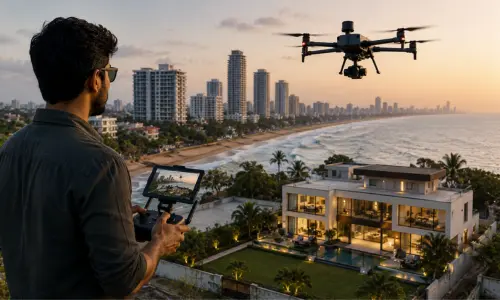
What the job involves: Media pilots capture aerial footage for films, weddings, events, news, and real estate marketing. Unlike survey or inspection work, this career is driven by creative skill as much as technical ability. A good cinematography pilot understands composition, lighting, tracking shots, and post-production editing, not just how to fly.
Real estate aerial photography is a strong entry point for beginners. Pilots shoot properties for marketing campaigns, site progress documentation, and neighbourhood context videos. This is high-volume, lower-margin work that builds skills quickly.
At the top end, experienced cinematographers working on feature films or large commercial campaigns earn the equivalent of Rs. 15.0 to Rs. 50.0 LPA.
Who hires: Film production houses, real estate developers, event management companies, news networks, and wedding photography agencies.
Additional skills needed: Camera settings (ISO, shutter speed, frame rates), video editing (Premiere Pro or DaVinci Resolve), and ideally FPV flying for high-speed creative shots.
Salary range: Full-time roles: Rs. 30,000 to Rs. 80,000 per month. Freelance shoots: Rs. 5,000 to Rs. 25,000 per day. Real estate shoots: Rs. 5,000 to Rs. 15,000 per property.
Growth outlook: Stable but competitive at the entry level. The market is saturated with consumer drone owners. The premium segment, covering high-end films, large events, and professional real estate, remains strong for pilots who invest in good equipment and editing skills.
Career 5: Drone Delivery and Logistics Operator
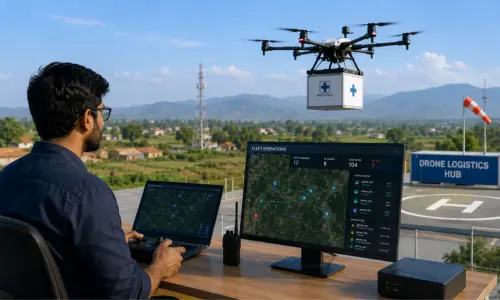
What the job involves: This is one of the fastest-growing careers in the sector, though it is still in an early phase in India. Logistics pilots manage autonomous drone deliveries of e-commerce parcels, medicine, and critical supplies. As operations scale, pilots increasingly function as fleet managers, monitoring multiple autonomous missions simultaneously, managing telemetry data, and taking manual control when a system encounters a problem.
Companies like Skye Air Mobility, Airbound, and Tech Eagle are building out commercial delivery networks across India, particularly for medical supply chains in hard-to-reach areas.
Who hires: Tech-logistics startups, medical drone delivery firms, and global logistics companies establishing Indian operations.
Additional skills needed: BVLOS (Beyond Visual Line of Sight) regulatory knowledge, Unmanned Traffic Management (UTM) software, and advanced aviation weather analysis.
Salary range: Junior operators: Rs. 5.0 to Rs. 9.0 LPA. Mid-level: Rs. 10.0 to Rs. 20.0 LPA. Senior logistics coordinators: Rs. 20.0 to Rs. 40.0 LPA.
Growth outlook: Very high future growth. As BVLOS regulations mature and battery technology improves, this sector will see the fastest expansion of any drone vertical in India between 2026 and 2031.
Career 6: Defence and Government Operations
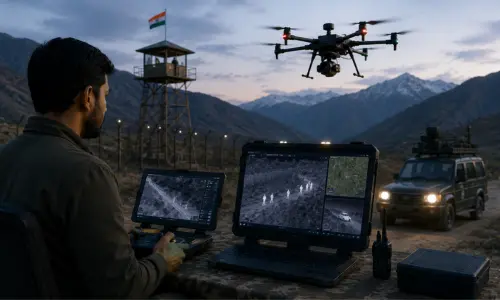
What the job involves: Defence drone pilots work on border surveillance, anti-poaching operations, tactical reconnaissance, disaster management, and urban crowd monitoring for state police departments. This is high-stakes work conducted in demanding environments, often using encrypted communication links and advanced night-vision or thermal payloads.
Civilian contractors working in defence tech are hired to support major drone manufacturing and testing programmes. Government employees in this space follow standard pay-commission scales but receive unmatched job stability and benefits.
Who hires: DRDO, Indian Armed Forces, state police departments, and private defence contractors including ideaForge, Adani Defence, and Tata Advanced Systems.
Additional skills needed: State security clearances, tactical operational training, counter-drone technology knowledge, and the ability to operate complex military-grade platforms.
Salary range: Civilian contractors start at Rs. 40,000 per month and senior roles cross Rs. 1,00,000 per month easily. Annual packages range from Rs. 6.0 to Rs. 60.0 LPA depending on the role and organisation.
Growth outlook: Very high. The government is executing a historic USD 2 billion indigenous defence drone procurement programme. Because civilian and defence drone platforms share 60 to 70 percent of common components, cross-sector hiring is already accelerating.
Career 7: Drone Pilot Trainer at a DGCA-Approved RPTO
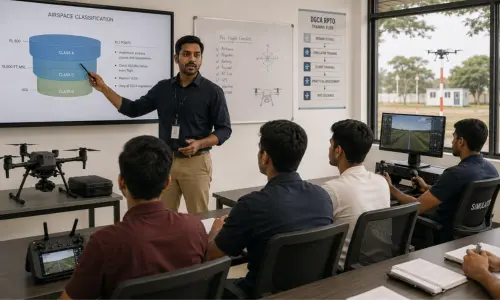
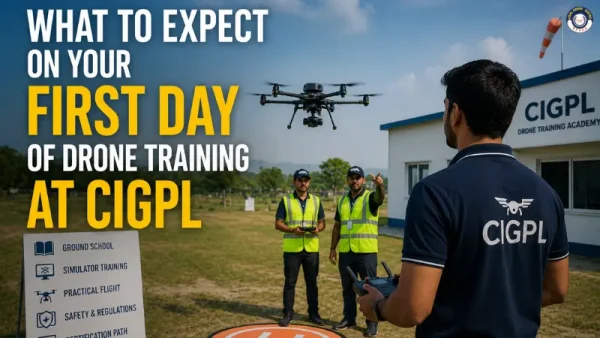
What the job involves: As more training institutes open to meet the demand for certified pilots, qualified instructors are increasingly hard to find. RPTO instructors deliver ground school lectures covering aviation law, meteorology, and airspace regulations, run simulator training sessions, and supervise live dual-control flight practice for students. They also conduct the final practical assessments required for RPC issuance.
This is one of the most stable drone careers available, with regular hours, standard corporate benefits, and no exposure to the physical rigours of field deployments.
Who hires: The 244 DGCA-approved RPTOs across India, including institutes in metro cities and rapidly expanding into Tier-2 and Tier-3 locations.
Additional skills needed: A DGCA Instructor License is required, which involves completing a Train The Trainer (TTT) programme and logging a minimum of 20 hours of verified flight experience. Strong communication and teaching skills matter here as much as flying ability.
Salary range: Rs. 40,000 to Rs. 70,000 per month, with senior instructors earning more based on their reputation and the volume of students they train.
Growth outlook: Surging. As RPTOs expand into smaller cities to support schemes like Namo Drone Didi, the demand for qualified instructors is growing faster than supply.
Career Summary: At a Glance
| Career Path | Monthly Salary Range (Rs.) | Growth Outlook |
|---|---|---|
| Agricultural Drone Pilot | 30,000 to 70,000 | Explosive |
| Surveying and Mapping Specialist | 40,000 to 90,000+ | High and Stable |
| Infrastructure Inspection Pilot | 35,000 to 90,000 | Rapidly Growing |
| Media and Cinematography Pilot | 30,000 to 80,000 | Stable |
| Drone Delivery and Logistics | 19,000 to 80,000+ | Very High (Future) |
| Defence and Government | 40,000 to 1,00,000+ | Very High |
| RPTO Instructor | 40,000 to 70,000 | Surging |
Can You Start Your Own Drone Business?
Yes, and many certified pilots do. Self-employed drone service providers focusing on agriculture spraying or surveying regularly earn Rs. 15 to Rs. 40 lakhs annually after the first three years of building their client base.
To run a legal drone services business, you need:
- A valid RPC for the drone category you operate
- A Type-Certified drone with a UIN registered on the Digital Sky Platform
- Third-party liability insurance
- WPC Equipment Type Approval for your radio systems
- A corporate registration (Private Limited or LLP) if you plan to bid for government tenders or B2B contracts
Startup costs for a small agri-drone or surveying business typically range from Rs. 5 to Rs. 30 lakhs depending on the equipment you choose.
What Skills Will Make You Earn More?
Your RPC is the legal baseline. What you earn above the baseline depends on what you bring beyond it.
Photogrammetry and GIS: Tools like Pix4D, ArcGIS, and Agisoft Metashape let you turn raw drone images into maps and 3D models. This skill alone can shift you from Rs. 4.0 LPA to Rs. 18.0 LPA.
LiDAR and Thermal Imaging: Operating these sensors correctly requires technical knowledge of calibration and data interpretation. Pilots who master them access the highest-paying enterprise roles in inspection and mapping.
BVLOS Certification: Flying beyond visual line of sight requires a special regulatory exemption. Pilots who qualify for BVLOS operations move straight into the Rs. 20.0 to Rs. 40.0 LPA salary band.
Drone Logbook: A well-maintained logbook documenting your flight hours, equipment operated, and incident-free missions is one of the strongest tools you have during salary negotiations. Enterprise employers use it to assess risk before assigning you to expensive equipment.
FAQs
No. The DGCA only requires you to be an Indian citizen between 18 and 65, have passed Class 10, hold a valid government ID, and pass a basic medical fitness test. Practical skills and data knowledge matter far more than academic qualifications in this field.
Defence and infrastructure inspection offer the highest corporate salaries, with senior pilots earning Rs. 30.0 to Rs. 60.0 LPA. Independent drone service businesses in surveying and agriculture can generate Rs. 15.0 to Rs. 40.0 LPA annually once established.
Many pilots find placement within a few weeks of certification, especially in agriculture and real estate. CIGPL connects its graduates with industry contacts as part of the training programme. The current supply-demand gap in the industry means hiring happens faster than in most sectors.
Not immediately. Freelancing works well once you have a skill set and a portfolio. Most pilots start with a salaried role to build experience, then move to freelancing or entrepreneurship after 1 to 2 years.
Drone delivery and logistics is expected to see the most aggressive growth between 2026 and 2031, as BVLOS regulations stabilise and battery technology improves. Defence manufacturing is also set for major expansion driven by a USD 2 billion government procurement
Absolutely. The Namo Drone Didi scheme is specifically designed to bring women into agricultural drone operations. Female drone pilots under this scheme earn Rs. 60,000 to Rs. 80,000 per month during peak seasons. Instructor and surveying roles are also fully open to women, with no industry barriers.
You can absolutely switch. Many pilots start in agriculture or media, then move into inspection or surveying once they develop additional skills. The RPC itself does not lock you into one sector.
Summary
Getting your DGCA drone pilot certificate is the starting point, not the finish line. What you do with it depends entirely on where you want to go.
Agriculture offers the most jobs right now and is a solid entry point, especially in rural India. Surveying and mapping offers the steepest salary growth for pilots who invest in data skills. Infrastructure inspection pays the most in the non-defence corporate world. Defence operations offer the highest ceiling and the greatest stability. And training others is a career that will only grow more valuable as the industry expands.
The common thread across all seven paths is this: the pilots who earn the most are not just good at flying. They understand the data, the regulations, and the business around the drone.
If you are ready to get started, our drone training programmes at CIGPL are DGCA-approved and designed to give you the practical foundation you need. You can begin with the Remote Pilot Certificate course and build from there. And if surveying and mapping is where you want to go, the Surveillance and Mapping Drone Course will prepare you for the highest-paying technical roles in the industry.
The market needs certified pilots. The question is whether you will be one of them.