What Happens If You Fly a Drone Without DGCA Certification in India?
Quick Summary
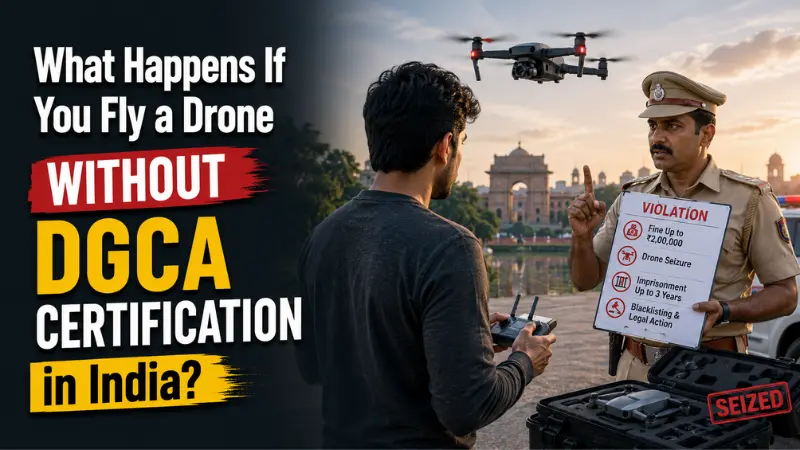
- Flying a drone without proper DGCA certification in India can result in fines up to Rs. 1,00,000, immediate confiscation of your drone, and in serious cases, criminal arrest without a warrant.
- Certification is not just one document. It covers four things: a Type Certificate for the drone model, a UIN (registration number), a Remote Pilot Certificate for the pilot, and valid third-party insurance.
- Real people have been arrested for flying drones at weddings, near airports, over temples, and close to government buildings. Ignorance of the law is not accepted as a defence.
- A proposed new law, the Draft Civil Drone Bill 2025, could raise the maximum jail term for airspace violations to three years.
Most people who buy a drone in India do not think of themselves as breaking the law. They buy it online, charge it up, head to an open field or a rooftop, and launch it. It feels harmless. It probably looks harmless.
But in the eyes of Indian aviation law, an uncertified drone in Indian airspace is treated the same way as an unregistered vehicle on a highway. Except the consequences are often much worse, because the risks involve more than just road safety. They involve national security, civil aviation, and the safety of people on the ground.
India’s drone laws are not ambiguous. The Drone Rules 2021, the Bharatiya Vayuyan Adhiniyam 2024, and a proposed new bill in 2025 have all moved in the same direction: stricter enforcement, heavier penalties, and less tolerance for non-compliance. This article explains exactly what happens if you fly without certification, who can catch you, what it costs you, and what real cases have looked like in Indian courts and police stations.
What Does "DGCA Certification" Actually Mean?
Before getting into consequences, it is worth being clear on what certification actually involves. A lot of people assume it is just one licence. It is not.
Legal drone operation in India requires four separate things to be in place:
Type Certificate: Before any drone model can be sold or operated in India, it must pass a technical evaluation and receive a Type Certificate from the DGCA. This certifies that the drone design meets minimum safety standards, including GPS capability, return-to-home function, and anti-collision lighting. Operating a drone without a Type Certificate means the hardware itself is not legally cleared for Indian airspace.
Unique Identification Number (UIN): Every individual drone unit must be registered on the Digital Sky Platform to receive a UIN. Think of it as the registration number for your drone. It is a mandatory requirement for all drones above 250g. Without it, there is no way for authorities to trace who owns the aircraft if something goes wrong.
Remote Pilot Certificate (RPC): The person flying the drone must hold a valid RPC obtained through training at a DGCA-approved RPTO. This is required for all commercial use and for any drone in the Small, Medium, or Large category regardless of purpose.
Third-Party Liability Insurance: Any drone above 250g must have valid insurance before it leaves the ground. If the drone crashes and injures someone or damages property, the insurance is supposed to cover it. Without it, you are personally liable for everything.
All four must be in place. Missing even one of them makes the flight illegal.
The Penalty Structure: What You Can Be Fined
The Drone Rules 2021 lay out a clear, tiered penalty structure based on the type of violation.
| Violation | Maximum Fine |
|---|---|
| Flying without a UIN (unregistered drone) | Rs. 50,000 |
| Flying without a Remote Pilot Certificate | Rs. 25,000 |
| Lending your RPC or UIN to someone else fraudulently | Rs. 50,000 |
| Flying in a Yellow or Red Zone without clearance | Rs. 1,00,000 |
| Importing a non-compliant drone without approvals | Rs. 5,00,000 |
These are the base fines. But there is a multiplier system built in that most people do not know about. The compounding fee, which is the fine you pay to settle the matter, is scaled based on the weight of the drone involved.
A Nano drone carries a 100% multiplier on the base fine. A Micro drone carries 200%. A Small drone carries 300%. A Medium drone carries 400%. And a Large drone carries 500%.
So if the base fine for flying without an RPC is Rs. 25,000, and you were flying a Small category drone, the actual compounding fee becomes Rs. 75,000. If you were flying a Medium category agricultural drone, it becomes Rs. 1,00,000.
Compoundable vs. Non-Compoundable: A Critical Difference
Not all violations can be settled with a fine. This is one of the most important things to understand about Indian drone law.
A compoundable offence is one where you can pay a fine and have the matter closed administratively, without going to court. Minor violations like flying an unregistered drone within a safe Green Zone fall into this category.
A non-compoundable offence cannot be settled with a fine. You must face formal criminal prosecution in a court of law, with the risk of a permanent criminal record and imprisonment. Violations of Rule 22 (flying in restricted Red or Yellow zones without permission) and Rule 27 (carrying arms, explosives, or dangerous goods) are both non-compoundable.
Non-compoundable offences are also classified as “cognizable,” which means police officers can arrest you immediately, without needing a warrant from a magistrate.
Who Can Catch You? It Is Not Just the DGCA
A common misconception is that only DGCA officials have the power to penalise drone pilots. In reality, local police are often the first to act.
Major airports, military installations, and sensitive areas use Counter-UAS technology to detect radio frequency signatures and track the exact location of a drone’s remote pilot on the ground. Once detected, local police converge on the pilot’s location rapidly.
When they reach you, they will ask for four things: the Type Certificate, the UIN, your RPC, and the Digital Sky flight plan for that specific session. If you cannot produce any of these, what happens next follows a clear sequence.
Your drone, remote controller, mobile device, and all storage media including SD cards are immediately seized on the spot. You are taken to the local police station where an FIR (First Information Report) is filed. Criminal charges can be filed under aviation law or under general criminal statutes like Section 287 of the Bharatiya Nyaya Sanhita (negligent conduct with machinery) or Section 188 (disobedience of public orders). The DGCA also runs a parallel administrative process and can levy the maximum statutory fine on top of whatever the criminal case brings.
You face two tracks of prosecution at the same time.
Real Cases: What Has Actually Happened in India
These are not hypothetical scenarios. People across India have been arrested, had their equipment seized, and faced criminal charges for exactly these situations.
Near Surat Airport:
Two individuals were arrested for flying a drone to film a political rally directly beneath the approach flight path of Surat airport. A commercial pilot spotted the drone during the landing phase and immediately alerted Air Traffic Control. The police tracked and arrested both the drone owner and the event organiser. Because the drone posed a direct threat to a passenger aircraft, the case was filed under Section 11 of the Aircraft Act, which relates to endangering public safety, not just a regulatory fine.
Near Tambaram Air Force Station, Chennai:
A drone fitted with a high-resolution camera was detected near the Indian Air Force station in Tambaram. The operators were hired for a local temple event but had no airspace clearance or DGCA certification. They were tracked down and detained by police. The equipment was seized and held pending formal security and espionage complaints from defence authorities.
Jagannath Temple, Puri:
A tourist and YouTube vlogger flew a drone over the Jagannath Temple, which is officially declared a Red Zone by the DGCA. He had no UIN, no RPC, and no zonal clearance. When he tried to get anticipatory bail to avoid arrest, the Odisha High Court refused. The court made clear that ignorance of digital zoning laws is not a legal defence.
Wedding Videographers in Hyderabad:
Police raided a function hall in Petbasheerabad and arrested three people, including the drone operator, his associate, and the function hall manager, for filming a wedding ceremony with an uncertified drone. They were charged under Section 188 of the Indian Penal Code for violating prohibition orders issued by the Cyberabad Commissioner of Police.
Wedding Photographer Near Madras High Court:
A photographer in Chennai launched a drone near the Madras High Court complex during a wedding shoot. He was detained and charged under Section 287 of the Indian Penal Code for negligence with machinery. His uncertified drone, worth Rs. 2.5 lakhs, was permanently seized.
The pattern across all these cases is consistent: the equipment is seized, criminal charges are filed, and courts have shown very little sympathy.
Your Insurance Will Not Save You Either
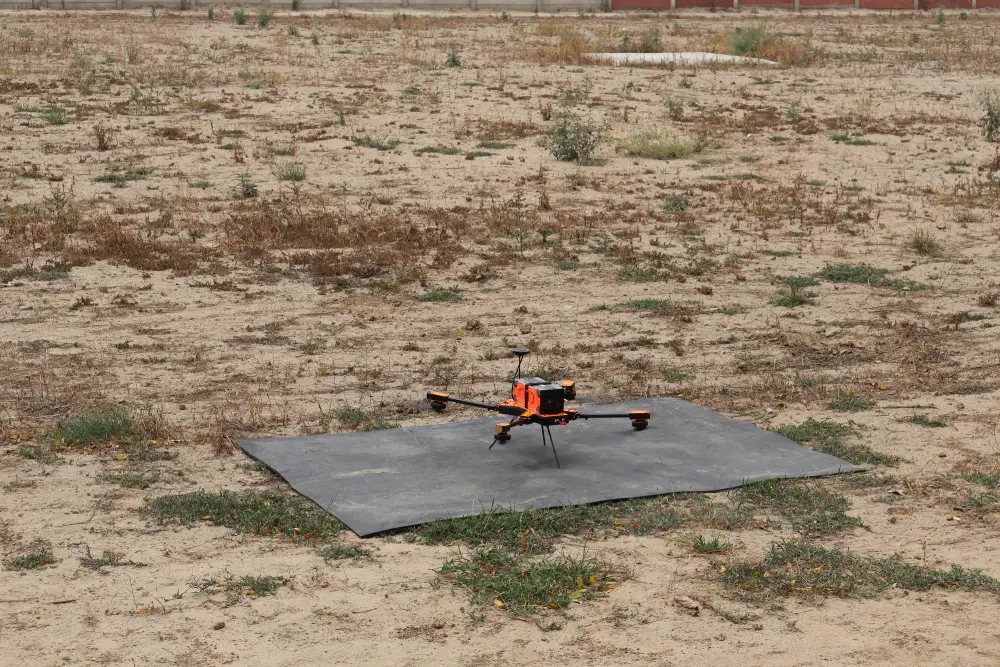
Here is something many people do not consider until it is too late. If you fly without certification and your drone crashes, injuring someone or damaging property, your insurance claim will be rejected outright.
Insurance policies for drones in India include clauses that make coverage contingent on lawful operation. If the flight was illegal because the drone lacked a UIN, the pilot lacked an RPC, or the flight took place in a restricted zone, the insurer will deny the claim entirely.
That leaves you personally liable for all costs. Medical expenses for the injured person. Property repair or replacement. Compensation for any loss of income. There is no upper limit on what a civil court can award in these cases.
The Draft Civil Drone Bill 2025, if passed, will make this even more severe. It proposes a strict liability framework where the drone owner does not even need to be proved negligent. If your drone caused the harm, you pay, regardless of intent. Minimum statutory compensation proposed under the Bill is Rs. 2.5 lakhs for a death and Rs. 1 lakh for grievous injury, with civil courts free to award far more.
Why People End Up Flying Without Certification (And Why That Is Not an Excuse)
Most people who get caught are not spies or smugglers. They fall into predictable categories of genuine ignorance.
The online buyer who assumes that buying a drone legally means flying it legally. It does not. A drone above 250g requires registration before its first flight.
The wedding videographer who does not know that commercial use of any drone, even a small one, requires an RPC. Multiple arrests across India have happened in exactly this context.
The social media vlogger who flies over a temple, monument, or tourist spot and uploads the footage to YouTube. Many of these sites are declared Red Zones. The uploaded video itself becomes timestamped evidence of the violation.
The city resident who lives within 12 km of an airport and launches a drone from their rooftop without realising their entire neighbourhood is classified as a Yellow Zone.
In every case, courts have refused to accept ignorance as a defence. The responsibility to check the Digital Sky Platform before every flight, verify certification requirements, and operate within the law rests entirely on the pilot.
What the 2025 Draft Bill Changes
The Draft Civil Drone (Promotion and Regulation) Bill 2025 has not been enacted yet, but it signals where enforcement is headed. Under the proposed law:
- Airspace violations (flying in Red or Yellow zones without permission) could attract up to three years in jail plus a fine of up to Rs. 1,00,000.
- Even lesser violations like operating without an RPC or UIN could attract up to one year in jail.
- Police would be empowered to detain drones and seize equipment based on suspicion alone, without needing immediate proof of a violation.
- Foreign nationals, importers, manufacturers, and even lessors of drones could be held accountable if an operator uses their equipment to conduct an illegal flight.
As of 2026, the Drone Rules 2021 remain in force. But the direction of travel is clear. Penalties are not getting lighter.
FAQs
If it weighs under 250g (Nano category) and you are using it purely for non-commercial recreation below 50 feet, you are generally exempt from RPC and UIN requirements. For anything heavier, or any commercial use, you need certification.
Yes. If the violation involves flying in a restricted zone or carrying prohibited payloads, it is a cognizable offence and local police can arrest you on the spot without a warrant.
Without a certified flight plan and proper documentation, you have no way to prove it was a mechanical failure rather than intentional. An uncertified operator has almost no legal defence in these situations.
Yes. Any commercial use of a drone, including filming paid events, requires an RPC regardless of the drone's size.
In minor cases, it may be returned after fines are paid and the matter is settled. In cases involving Red Zone violations, national security concerns, or criminal charges, the drone is typically kept as evidence and may be permanently confiscated.
The RPC covers your qualification as a pilot. You also need your drone to have a Type Certificate and UIN, and you need valid insurance. All four together make a flight legal. Any one missing makes it illegal.
Stop flying immediately. Register your drone on the Digital Sky Platform, check whether your drone model has a Type Certificate, and enrol in an RPC course at a DGCA-approved RPTO to get certified before your next flight.
Summary
Flying a drone without certification in India is not a minor paperwork issue. People have been arrested at weddings, near temples, close to airports, and beside government buildings. Courts have denied bail. Drones worth lakhs have been permanently seized. Criminal records have followed.
The rules are not going to get easier. The Draft Civil Drone Bill 2025 proposes criminal jail terms for violations that currently only carry fines. Enforcement technology is improving. And courts have made it clear that ignorance of the law is not a defence.
The path to flying legally in India starts with getting your Remote Pilot Certificate through a DGCA-approved RPTO. That covers you as a pilot. Your drone also needs to be registered with a UIN, have a valid Type Certificate, and carry third-party insurance. You can see the approvals and certifications that CIGPL holds as a legally recognised training institute on our certifications page.
The sky is genuinely open for certified pilots in India right now. The demand for skilled drone operators is high, the career opportunities are real, and the government is actively supporting the industry. But none of that applies to uncertified operators. For them, every flight is a risk that no amount of skill or good intentions can protect them from.