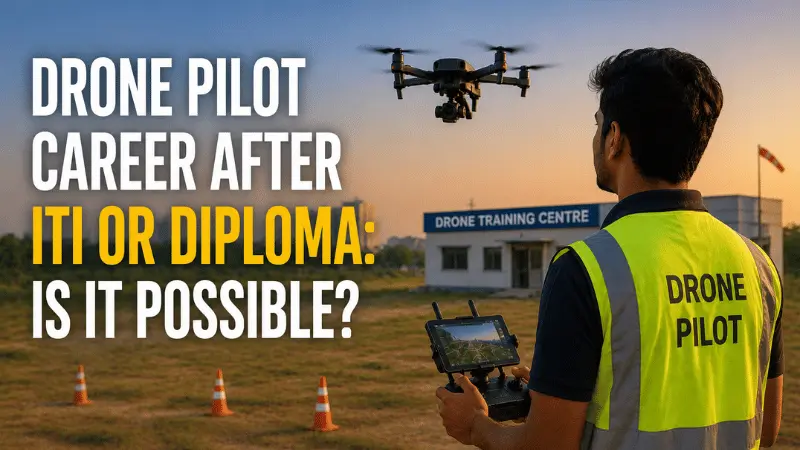
Drone Pilot Career After ITI or Diploma: Is It Possible?
Quick Summary
- Yes, completely. The DGCA only requires a Class 10 pass to get a Remote Pilot Certificate. ITI and diploma holders already meet and exceed this requirement.
- Technical trades like Electronics, Electrician, Fitter, Surveyor, and COPA give ITI graduates a genuine advantage in drone operations and maintenance that purely academic candidates do not have.
- A freshly certified drone pilot earns Rs. 25,000 to 45,000 per month, which is 100 to 150 percent more than a typical entry-level ITI trade job.
- The government has created a specific NSQF-certified Drone Technician trade under ITI and a Drone Service Technician qualification under AASSC, both designed specifically for vocationally trained students.
If you have completed your ITI or a diploma and are wondering whether the drone industry is accessible to you, the straightforward answer is yes. Not just accessible but genuinely well-suited.
There is a widespread assumption that drone piloting requires an engineering degree or some kind of aviation background. It does not. The DGCA requires a Class 10 pass to apply for a Remote Pilot Certificate. If you completed an ITI or diploma, you passed Class 10 before you even started. You already meet the educational requirement.
What many people do not realise is that ITI and diploma training in trades like Electronics, Electrician, Fitter, and Surveyor provides exactly the kind of technical foundation that makes a drone operator more valuable, not less. An operator who can fly the drone and fix it on-site in a field 50 kilometres from the nearest town is worth significantly more to an employer than someone who can only fly.
This article explains how your existing qualification connects to drone certification, which trades give you the biggest advantage, what you can earn, and how to get started.
Does Your ITI or Diploma Qualify You for Drone Training?
Yes. Here is the exact regulatory position.
Under the Drone Rules 2021, the DGCA requires candidates for a Remote Pilot Certificate to be an Indian citizen, between 18 and 65 years of age, with a minimum educational qualification of a Class 10 pass.
ITI admission requires a Class 10 pass. Diploma admission requires a Class 10 pass. So your matriculation certificate, which you used to get into ITI or diploma, is also what the DGCA needs. The ITI certificate or diploma itself adds professional credibility on top of the basic requirement.
| Eligibility Requirement | DGCA Standard | ITI or Diploma Graduate |
|---|---|---|
| Minimum education | Class 10 pass | Already met before ITI/diploma entry |
| Age | 18 to 65 years | Met by typical graduation age |
| Medical fitness | Basic fitness declaration | Standard compliance |
| Identity proof | Aadhaar or government ID | Standard compliance |
| Training | 5 to 7 days at DGCA-approved RPTO | Must complete course |
The educational bar is set low deliberately. The government wants a broad, diverse workforce for the drone industry. That includes farmers, ITI graduates, diploma holders, and rural entrepreneurs, not just engineering graduates.
Which ITI Trades Give You the Biggest Advantage?
Electronics Mechanic
This is one of the most directly applicable trades. Modern drones run on Printed Circuit Boards, Electronic Speed Controllers, Flight Controller Boards, and radio frequency telemetry systems. An electronics mechanic understands how these components work, how to test them with a multimeter or oscilloscope, and how to solder and replace damaged parts.
When a drone suffers a hard landing and the GPS module stops working or the telemetry link fails, an electronics-trained operator can diagnose the fault on-site and fix it. That saves the employer the cost of shipping the drone to a manufacturer and waiting days for a repair.
Electrician
Drones use high-capacity Lithium Polymer (LiPo) and Lithium-Ion battery packs. These batteries generate intense heat during discharge and can cause fires if mishandled. Thermal runaway, which happens when a damaged or improperly charged battery overheats, is one of the most serious hazards in commercial drone operations.
An electrician understands voltage regulation, cell imbalance, resistance, and the physics of heat in electrical systems. They know how to charge batteries safely, identify a failing cell before it becomes dangerous, and manage battery packs through their operational lifecycle in ways that a non-technical pilot simply would not know to do.
Fitter, Machinist, and Mechanical Trades
Drones have carbon-fibre airframes, precision-balanced brushless motors, and delicate payload mounting systems. Mechanical training gives operators the ability to check structural integrity after a hard landing, dynamically balance motors, torque fasteners correctly, and integrate payloads like LiDAR sensors or gimbal cameras to manufacturer specifications.
Under the Drone Rules 2021, commercial drones must conform to their DGCA Type Certificate. Unauthorised component substitution or imprecise repairs can invalidate the drone’s registration and make it illegal to fly. A mechanically trained operator ensures every repair stays within approved tolerances.
Surveyor and IT/COPA Trades
The Surveyor trade specifically includes remote sensing, satellite imagery, and spatial data processing in its syllabus. Graduates from this trade can move into aerial photogrammetry much faster than someone without that background. They understand how to place Ground Control Points, interpret orthomosaic maps, and calculate volumetric data for mining and construction clients.
IT and COPA graduates bring the software literacy needed for complex flight planning, automated mission programming, and handling the large datasets generated by high-resolution drone sensors.
What the Government Has Built Specifically for ITI Students
The government has not just opened the drone industry to ITI graduates. It has built specific programmes inside the ITI system for drone technology.
Drone Technician Trade (DGT/NCVT, NSQF Level 3): This is a six-month, 600-hour ITI course covering aerodynamics, electronic speed controllers, flight controller boards, GPS and telemetry modules, and hands-on assembly, calibration, and repair. It awards a National Trade Certificate. You can pursue this directly within the ITI framework.
Drone Service Technician (AASSC/ESSCI, NSQF Level 4): This 400 to 450-hour programme is designed for ITI certificate holders with one year of relevant experience, or Class 12 pass students. It covers advanced diagnostics, payload calibration, safety checks, and electronic waste management. The qualification pack code is ELE/Q7003. This is the industry-recognised credential for professional drone maintenance roles.
| Certification | Body | NSQF Level | Duration | Who It Is For |
|---|---|---|---|---|
| Drone Technician (CTS) | DGT / NCVT | Level 3 | 6 months (600 hours) | 10th pass, ITI students |
| Drone Service Technician | AASSC / ESSCI | Level 4 | 400 to 450 hours | ITI graduate with 1 year experience, or 12th pass |
| Remote Pilot Certificate | DGCA | Aviation standard | 5 to 7 days | 10th pass, 18 to 65 years |
PMKVY 4.0: The Pradhan Mantri Kaushal Vikas Yojana provides free or heavily subsidised skill development programmes for drone-related roles. Courses like Drone Service Technician and Drone Monitoring and Maintenance Technician are funded under this scheme, reducing the financial barrier for vocationally trained candidates.
What Can You Actually Earn?
This is where the numbers become compelling. Here is how drone certification changes the salary picture compared to a standard ITI trade job.
A typical ITI graduate entering a manufacturing or electrical role starts at Rs. 12,000 to Rs. 18,000 per month. That is the baseline for most industrial trade jobs in India.
A freshly certified drone pilot starts at Rs. 25,000 to Rs. 45,000 per month. That is an immediate increase of 100 to 150 percent over a standard ITI entry salary.
| Certification | Body | NSQF Level | Duration | Who It Is For |
|---|---|---|---|---|
| Drone Technician (CTS) | DGT / NCVT | Level 3 | 6 months (600 hours) | 10th pass, ITI students |
| Drone Service Technician | AASSC / ESSCI | Level 4 | 400 to 450 hours | ITI graduate with 1 year experience, or 12th pass |
| Remote Pilot Certificate | DGCA | Aviation standard | 5 to 7 days | 10th pass, 18 to 65 years |
The training investment is recovered quickly. RPTO course fees range from Rs. 18,000 at subsidised institutes to Rs. 75,000 at private academies. At an entry salary of Rs. 25,000 to 45,000 per month, most pilots recover their training cost within two to four months of starting work.
The reason the salary premium exists is simple: the market is undersupplied. India currently has under 40,000 certified pilots but needs 1,00,000 by 2030. Certified pilots with technical maintenance skills are even rarer.
Career Paths That Open Up
Getting your RPC is the starting point. Here is where it can lead.
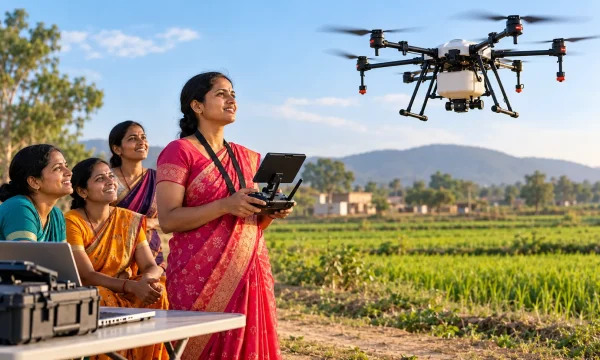
Agricultural drone pilot: The highest-volume employment sector in India right now. Companies like Garuda Aerospace, Leher, and Dhaksha Unmanned Systems deploy large fleets and need pilots who can also handle on-site maintenance. Your technical background is directly useful here.
Drone maintenance engineer: As agricultural cooperatives and infrastructure companies scale their fleets, dedicated maintenance roles are growing fast. An operator with NSQF Level 4 Drone Service Technician certification and an RPC is ideally positioned for fleet maintenance manager roles earning Rs. 8.0 to 12.0 LPA.
Survey and GIS operator: The SVAMITVA scheme and NHAI mandate require large numbers of surveying-capable pilots. Your Surveyor or COPA background plus an RPC and basic photogrammetry software training puts you into this well-paying sector.
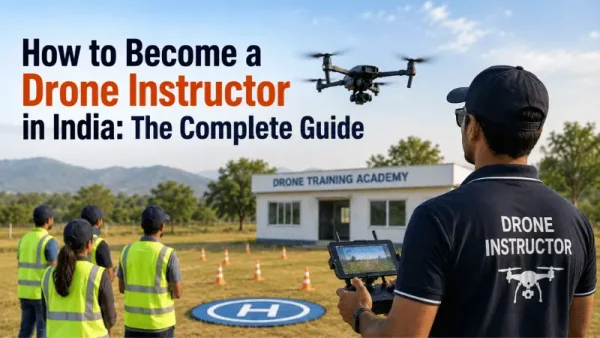
RPTO instructor: The DGCA allows RPC holders with a diploma or degree (or equivalent 10th pass), a minimum of 20 hours of specific flight experience, and completion of a Train the Trainer programme to become certified drone pilot instructors. Teaching others at an RPTO is a stable, well-compensated role that directly values your technical background.
Drone manufacturer technician: The PLI scheme for domestic drone manufacturing has expanded production lines. OEMs are recruiting electronics and mechanical ITI graduates for assembly, quality control, and after-sales service roles.
The Skills That Make You Stand Out
Your technical ITI background already differentiates you. Here is what you can add to push into higher salary brackets.
GIS and photogrammetry software: Pix4D, Agisoft Metashape, ArcGIS, QGIS. The ability to turn raw drone imagery into 3D maps and volumetric reports adds 28 to 35 percent to your salary over base-level pilots. This is the single highest-return additional skill in the industry.
Thermal imaging: Understanding how to operate radiometric thermal cameras and interpret temperature data. Essential for solar farm inspection, power grid monitoring, and energy sector work.
LiDAR processing: Required in mining, highway surveying, and environmental mapping. Pushes salaries into Rs. 85,000 to 1,15,000 per month range at senior level.
Python or basic coding: Drone simulation, autonomous mission programming, and automated path planning roles start at Rs. 8 to 11 LPA and reach Rs. 18 to 22 LPA mid-career. Diploma graduates with coding aptitude have a genuine advantage here.
If you are interested in building data processing skills alongside your RPC, our Surveillance and Mapping Drone Course covers the photogrammetry and GIS fundamentals that the highest-paying technical roles demand.
FAQs
No replacement is needed. You passed Class 10 to get into ITI, so your matriculation certificate already satisfies the DGCA requirement. Your ITI certificate is additional proof of technical competence that makes you more employable.
Yes. PMKVY 4.0 funds Drone Service Technician and Drone Monitoring and Maintenance Technician courses for free or at subsidised rates. State-level Skill India programmes also offer funded training in some states.
Significantly. An operator who can fly the drone and repair it on-site in a field environment is worth far more than one who can only fly. Industry data shows technically skilled pilots earn 28 to 35 percent more than baseline operators.
Yes. The DGCA allows RPC holders with a diploma or equivalent, a minimum of 20 hours of specific flight experience, and a Train the Trainer certification to teach at approved RPTOs. This is a direct career progression for experienced ITI-background pilots.
Yes. The DGT has formally established the Drone Technician trade under the Craftsmen Training Scheme, and it is available at ITI centres across the country. Check the DGT website for institutes offering this trade in your state.
The RPC course at a DGCA-approved RPTO takes 5 to 7 days. Your RPC is issued digitally within 7 to 15 days after the RPTO uploads your assessment data. So from deciding to enrol to having your certificate in hand, the timeline is roughly two to three weeks.
The main challenges are environmental rather than aeronautical. Extreme heat degrades LiPo batteries faster than normal and increases thermal runaway risk. Poor mobile connectivity in rural areas can disrupt GPS-assisted flight. Your electrical or mechanical background gives you a direct advantage in managing both of these risks safely.
Summary
The short answer to the question this article started with: yes, a drone pilot career after ITI or diploma is not just possible. It is one of the more logical career transitions available to technically trained graduates in India right now.
The educational requirement is already met. The technical skills from your trade translate directly into field advantages. The salary jump from a standard ITI job to a certified drone pilot role is immediate and significant. And the industry is undersupplied, which means the job market actively favours candidates who are ready to step in.
The government has built specific pathways inside the ITI system for drone technology, from the six-month Drone Technician trade to the NSQF Level 4 Drone Service Technician qualification. These exist precisely because the industry needs technically trained people, not just flyers.
Your first step is getting your Remote Pilot Certificate at a DGCA-approved institute. Take a look at our drone training programmes at CIGPL, where our Remote Pilot Certificate course is designed to be accessible to students from all educational backgrounds. Your technical skills are already an asset. The certification is what makes them commercially deployable.