How Women Are Building Careers in Drone Technology in India
Quick Summary
- Women now make up an estimated 15 percent of India’s certified drone pilot workforce, significantly higher than the 5 to 10 percent average seen in Western markets.
- The Namo Drone Didi scheme has distributed over 1,094 drones to women-led Self Help Groups, with active operators earning Rs. 60,000 to Rs. 80,000 per month during peak agricultural seasons.
- Career paths for women in the drone sector go well beyond spraying crops and include GIS analysis, drone data processing, flight instruction, surveillance operations, and hardware engineering.
- India has deliberately engineered female participation in drone technology from the top down, making it one of the few countries where women are genuinely mainstream in the commercial drone workforce.
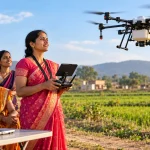
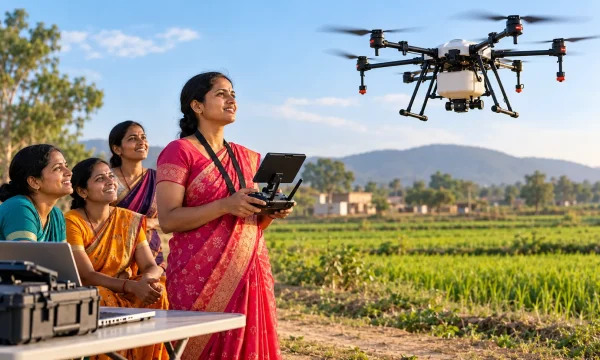
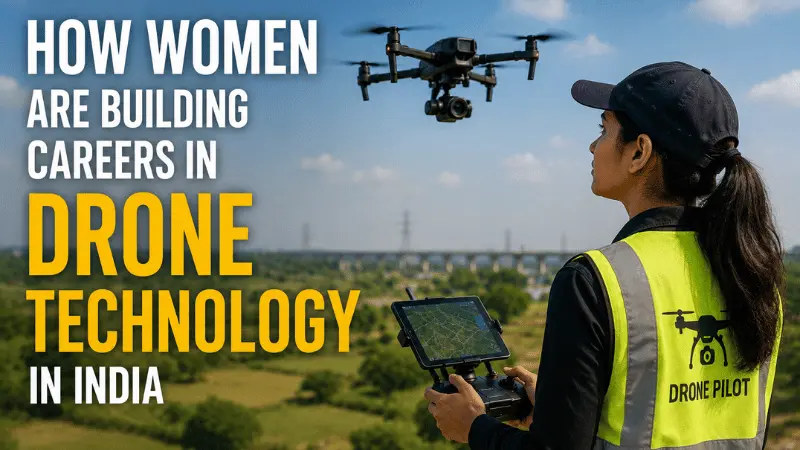
In a paddy field in Tamil Nadu, a 27-year-old mathematics postgraduate named Nandhini Sugumar is steering a drone over rows of crops. She was provided a Rs. 7 lakh drone package completely free of cost under a government scheme. She now covers her local farms in minutes, charges Rs. 400 per acre, and earns more in a single month than many of her peers earn in a year.
In Haryana, Nisha Solanki has become the state’s first certified female drone pilot. She does not just fly. She trains farmers, demonstrates spray techniques, and has now personally visited over 250 farms to shift local agricultural practice toward drone technology.
In Pune, a young engineer named Aarohi Patil won a national drone innovation challenge by designing an entirely eco-friendly drone architecture. In Chennai, an instructor named Lakshmi Nair has personally certified over 200 women pilots, focusing her recruitment specifically on candidates from rural and economically marginalised backgrounds.
These are not isolated stories. They are part of a deliberate, government-backed, and rapidly accelerating movement that is putting India ahead of most of the world when it comes to women in drone technology.
This article covers how that movement works, who is driving it, what women are actually earning, what challenges still exist, and what the road ahead looks like.
Where Women Stand in India's Drone Workforce Right Now
As of early 2026, India has 42,412 DGCA-certified remote pilots trained across 251 approved RPTOs. Based on institutional data from Drone Destination, India’s largest DGCA-approved training organisation, women constitute approximately 15 percent of certified drone pilots. That translates to an estimated 6,360 female certified drone pilots across the country.
| Metric | Data (2026) |
|---|---|
| Total DGCA-certified remote pilots | 42,412 |
| Estimated female certified pilots | ~6,360 |
| Female workforce representation | ~15% |
| Approved RPTOs nationally | 251 |
| Female participation in agri-tech training pipelines (SFI data) | 53% |
Fifteen percent may not sound dramatic on its own. But compare it to global benchmarks. In the United States and across the European Union, female commercial drone pilot representation typically sits between 5 and 10 percent. India’s 15 percent is not the result of organic cultural change. It is the result of deliberate policy design that routed drone technology directly through female-led networks rather than waiting for it to filter through traditionally male-dominated aviation and hobbyist communities.
The pipeline is even more striking than the current numbers. The Syngenta Foundation India has trained 19,348 agri-entrepreneurs in modern farming technologies, with women making up 53 percent of that cohort. A significant portion of these women are entering the drone economy for the first time.
The Namo Drone Didi Scheme: How It Actually Works
The Namo Drone Didi scheme was launched on November 30, 2023, by Prime Minister Narendra Modi. It operates under the Ministry of Agriculture and Farmers Welfare and works through the Deendayal Antyodaya Yojana National Rural Livelihoods Mission (DAY-NRLM) network of Women Self Help Groups.
The objective is straightforward: equip 15,000 Women SHGs with agricultural drones and train them to run drone spraying service businesses in their local farming communities.
What Each SHG Receives
The scheme does not simply hand over a drone. Each SHG receives a complete operational package:
- A commercial agricultural drone with liquid spray assembly
- One standard battery set plus four spare battery sets
- A dual-channel fast battery charger and charger hub
- Spare propellers, nozzle sets, and basic tools including an anemometer and pH meter
- One-year comprehensive insurance
- Two-year annual maintenance contract
The Financial Structure
The Central Financial Assistance covers 80 percent of the total drone package cost, capped at Rs. 8 lakhs per SHG. The remaining 20 percent is financed through the Agriculture Infrastructure Fund (AIF) at a 3 percent annual interest subvention, making the entry cost genuinely manageable for rural cooperative groups.
The Training Programme
One SHG member receives 15 days of intensive training at a DGCA-approved RPTO. The first 5 days cover theory and simulator training for the Remote Pilot Certificate: rotorcraft flight principles, radio telephony, meteorology, and aviation regulations. The remaining 10 days focus entirely on agricultural application: field mapping, chemical mixing, and precision spraying techniques.
A second member of the SHG receives 5 days of drone assistant training covering battery management, payload refilling, and basic mechanical repairs.
What Women Are Actually Earning
The numbers from a study by the Agricultural Development and Rural Transformation Centre (ADRTC) in Bangalore are specific and verified.
Standard agricultural drones cover one acre in 7 to 8 minutes. Active Drone Didis charge between Rs. 379 and Rs. 400 per acre. Working consistently during peak agricultural seasons, operators are generating Rs. 60,000 to Rs. 80,000 per month.
The study also found that 99 percent of farmers who used drone spraying services said they would recommend it to other farmers, driven by a reported 97 percent reduction in water usage compared to manual spraying and highly competitive service costs.
Servicing between 2,000 and 2,500 acres annually, each SHG is projected to generate at least Rs. 1 lakh in additional annual income, which is the government’s “Lakhpati Didi” threshold. After the AIF loan is repaid, the drone becomes a pure profit-generating asset.
State-wise Distribution (Initial Phase)
| State | Drones Distributed | Total Allocation Target |
|---|---|---|
| Karnataka | 145 | 824 |
| Andhra Pradesh | 108 | 440 |
| Haryana | 102 | 583 |
| Madhya Pradesh | 89 | 1,066 |
| Maharashtra | 60 | 1,612 |
| Gujarat | 58 | 1,024 |
| Punjab | 57 | 1,021 |
| Bihar | 32 | 999 |
Real Stories: Women Who Are Already There
Nisha Solanki, Haryana: The first certified female drone pilot in the state, Nisha has moved beyond personal operations into community leadership. She actively trains farmers across districts, has demonstrated drone spraying techniques on over 250 individual farms, and is actively reshaping how her region thinks about agricultural technology.
Nandhini Sugumar, Tamil Nadu: A 27-year-old mathematics postgraduate who received her drone under the Namo Drone Didi scheme. She now commands professional service fees from farmers in her community and earns far more than any traditional income option available to her before certification.
Sita, near Manesar, North India: Previously a manual agricultural labourer. After completing her DGCA certification at an approved RPTO, she now operates an independent local drone service business, sets her own rates, and works on her own terms.
Career Paths Beyond Spraying Crops
Agricultural spraying is the entry point for most rural women entering the drone sector. But the industry offers significantly more.
| Career Path | What It Involves | Salary Range |
|---|---|---|
| GIS and Drone Data Analyst | Converting photogrammetry data into orthomosaics, CAD drawings, and 3D models for SVAMITVA mapping and infrastructure projects | Rs. 4.0 to 7.0 LPA |
| Drone Pilot Instructor | Teaching DGCA-compliant flight training at RPTOs. Requires RPC and logged flight hours | Institutional salary, variable |
| UAV Flight Operations Specialist | Managing complex commercial missions including medical logistics, BVLOS deliveries, and utility inspections | Rs. 4.5 LPA and above |
| Drone Hardware Technician | Assembly, calibration, and repair of multi-rotor and fixed-wing systems | Rs. 3.5 to 5.0 LPA |
| OSINT and Surveillance Analyst | Combining drone imagery with satellite data for law enforcement, maritime monitoring, and intelligence work | Rs. 5.0 LPA and above |
The SVAMITVA scheme alone has generated massive sustained demand for GIS analysts and data processors. Because the scheme is mapping over 3.44 lakh villages with centimetre-scale accuracy, it creates long-term contracts for qualified women who can handle post-flight data processing, not just flight operations.
Other Government Schemes Supporting Women in Drone Technology
SwaYaan (MeitY): A Rs. 89.87 crore capacity-building initiative with a hub-and-spoke model across 30 premier institutions including IITs and NITs. SwaYaan has trained over 32,000 beneficiaries with explicit targets for female inclusion in drone electronics, aeromechanics, and guidance, navigation, and control systems. It has already surpassed this number.
NIDAR (National Innovation Challenge for Drone Application and Research): Operating under the SwaYaan umbrella, NIDAR offers a Rs. 40 lakh prize pool and startup incubation support for autonomous drone solutions in disaster response and precision agriculture. Open to students and researchers.
PMKVY 4.0: Has enrolled and trained 25,791 candidates in drone technology-related job roles at the vocational level, with strong female participation targets.
PLI Scheme for Drones: The manufacturing expansion driven by this Rs. 120 crore scheme has created over 2,650 high-tech assembly and engineering jobs, with women entering hardware production roles for the first time.
State-level efforts: Telangana’s Research and Innovation Circle of Hyderabad (RICH) has partnered with Syngene International to launch STEM scholarships for women feeding into the state’s agri-tech and drone corridors. Tamil Nadu has established the Tamil Nadu Unmanned Aerial Vehicles Corporation in collaboration with Anna University, a 100 percent government-owned company deploying drones for law enforcement and agricultural analysis.
Women Who Are Pioneering the Sector
Dr. Ruchi Saxena, Director of India Flying Labs: A leading global advocate for using drones in healthcare delivery and disaster management. She has shifted industry narratives away from purely commercial or military applications toward community-led drone networks solving last-mile logistical failures.
Smriti Mishra, Drone Engineer, Odisha: Recognised across the industry for her contributions to hardware engineering and the indigenisation of drone components, reducing reliance on imported airframes.
Priya Sharma, Software Developer, Hyderabad: Designed an AI-powered drone navigation system enabling autonomous flight optimisation in degraded environments, now deployed in disaster relief operations nationally.
Lakshmi Nair, Master Trainer, Chennai: Has personally certified over 200 women pilots, deliberately recruiting from rural and economically marginalised backgrounds. She is one of the most productive human capital builders in the sector.
Aarohi Patil, Technologist, Pune: Won the 2024 Drone Innovation Challenge with an eco-friendly drone design, representing the next generation of aerospace innovators coming through India’s academic pipeline.
The Challenges That Still Exist
It is important to be honest about the barriers alongside the successes.
Transportation and logistics: The ADRTC evaluation found that 42.68 percent of Drone Didis faced severe difficulties transporting heavy equipment to remote fields. In Southern India, this figure was 78.82 percent. The government responded by amending SMAM to provide an 80 percent subsidy on multi-utility vehicles for drone transport.
Battery and infrastructure limitations: Agricultural drones fly for 5 to 20 minutes per battery charge. In villages with erratic electricity supply, recharging four spare batteries becomes a genuine bottleneck. The lack of local repair hubs means any hardware fault can cut into an operator’s seasonal earnings significantly.
Market development: Many rural farmers remain sceptical of drone technology compared to cheap manual labour. Operators often need to act as salespeople and agronomists to build their local client base, not just as pilots.
Mentorship gaps: Dr. Nagaraj, a veteran in the Indian drone industry, points to the acute shortage of senior women leaders available to mentor younger entrants. The journey can feel isolating when there are few women ahead of you in the same field.
How Drone Earnings Compare to Traditional Rural Options
The economic shift for women who enter drone technology is significant.
| Metric | Traditional Rural Employment | Drone Technology Operator |
|---|---|---|
| Role | Manual labourer or assistant | Technical specialist and business owner |
| Monthly earnings | Subsistence wages | Rs. 60,000 to 80,000 (peak season) |
| Skill status | Easily replaceable | DGCA-licensed, legally protected |
| Long-term trajectory | Subsistence | Lakhpati Didi (Rs. 1 lakh+ annual surplus) |
The certification creates a legally protected, specialised skill set that cannot simply be undercut by cheaper labour. This is a fundamentally different economic position from anything previously available to most rural women.
India's Position Globally
In most Western countries, female commercial drone pilot representation sits between 5 and 10 percent. India’s estimated 15 percent outperforms this significantly.
The reason is the mechanism of growth. In Western markets, the drone industry evolved from male-dominated hobbyist RC communities and legacy aviation. India engineered a top-down policy transfer: by routing subsidised drone technology through the female-exclusive SHG network, the government bypassed traditional male-dominated entry points entirely. Women were not waiting to be invited in. The technology was placed directly in their hands through a programme designed for them.
This makes India a genuine global benchmark for gender inclusion in deep tech, not because of cultural factors but because of deliberate policy design.
What the Future Looks Like (2026 to 2030)
The Indian commercial drone market is projected to reach USD 2.58 billion by 2030, growing at a CAGR of 20 to 24 percent. The opportunities for women will expand proportionally.
Garuda Aerospace has committed Rs. 100 crore to develop the Andhra Pradesh Drone City in Kurnool, targeting the training of 25,000 new pilots and incubation of 500 UAV startups. The Union Budget 2026-27 introduced SHE-Marts to guarantee market access for female-led drone businesses and She-Mark certifications to streamline enterprise financing.
The bigger shift between now and 2030 is technological. As autonomous platforms and BVLOS operations over 5G networks replace manual Visual Line of Sight flying, the workforce will shift from physical piloting toward remote mission planning, GIS analysis, and algorithmic data processing. These are cognitive, often remote-work-compatible roles that will further dismantle geographic barriers for women in smaller cities and rural areas.
Advice from Women Already in the Industry
The consistent advice from those already working in this sector is practical rather than inspirational.
Do not treat the Remote Pilot Certificate as the finish line. It is the entry ticket. The women earning the most and progressing fastest are those who layered additional skills on top of their RPC: GIS software, photogrammetry processing, BVLOS operations, or agricultural analytics.
Seek out mentors and networks actively. The Drone Federation of India, the NITI Aayog Women Entrepreneurship Platform, and various RPTO alumni communities are genuine resources, not just names on a webpage.
The physical difficulty of field work is real, particularly in agricultural operations. Plan for the logistics, not just the flying.
FAQs
No. The DGCA requires a Class 10 pass, a valid government ID, and a basic medical fitness certificate from an MBBS doctor. Engineering backgrounds help for data analysis roles but are not needed for the RPC itself.
Yes. The Namo Drone Didi training programme is specifically designed for women without prior technology backgrounds. The 15-day curriculum builds from absolute basics to live flight operations.
Agricultural drone operations involve carrying equipment, mixing chemical payloads, and swapping batteries repeatedly. It is physical work. The government now provides transport vehicle subsidies specifically to ease this burden for Drone Didis.
Yes. Urban career paths include GIS analysis, infrastructure inspection, surveillance operations, drone pilot instruction, and software roles. These are desk-compatible or urban-field roles with strong salary growth.
Agricultural operators typically start taking service bookings within days of completing training. The certification process through the RPTO takes 7 to 15 days after the course ends. Most operators start generating income within a month of certification.
The reality is mixed. Government schemes have actively created female-dominated entry points in agriculture. Corporate and urban roles are more mixed. The mentorship gap is real, particularly at senior levels. But the trajectory is strongly positive, and formal frameworks now actively support female participation.
CIGPL offers DGCA-approved drone training programmes accessible to women from any background. Our Remote Pilot Certificate course covers the full curriculum from aviation theory to live flight. If you are interested in data analysis and mapping roles, the Surveillance and Mapping Drone Course builds the additional skills that the highest-paying technical roles require.
Summary
India’s women in drone technology story is not a niche feel-good narrative. It is a data-backed, policy-driven shift that has already put thousands of women into a genuinely lucrative, legally protected technical profession.
The Namo Drone Didi scheme created the entry point. The SVAMITVA scheme created sustained demand for GIS analysts. SwaYaan is building the next generation of female engineers and data specialists. And women like Dr. Ruchi Saxena, Lakshmi Nair, and Aarohi Patil are proving that the ceiling in this industry does not exist.
The challenges are real: transport logistics, infrastructure gaps, mentorship shortages, and sceptical rural markets. But the direction is clear and the momentum is building.
For women considering this career, the starting point is the same as it is for everyone: a DGCA Remote Pilot Certificate from an approved training institute. From there, the paths are genuinely varied. Take a look at our drone training programmes at CIGPL to see what your first step looks like.
The sky in India is becoming a much more equal place.