How Much Does It Cost to Get a Drone Licence in India in 2026?
Quick Summary
- The government’s official fee for a Remote Pilot Certificate is just Rs. 100. The actual total cost ranges from Rs. 27,000 at the budget end to Rs. 1,16,500 at the premium end, with Rs. 55,000 to Rs. 90,000 being the realistic middle-ground budget for most students.
- The RPTO training fee is the biggest single cost, ranging from Rs. 19,000 to Rs. 1,00,000 depending on the category, location, and institute.
- Several costs are routinely left out of advertised prices: travel to a Green Zone flying area, accommodation during the course, mandatory insurance, and the medical certificate.
- For eligible women in rural areas, the Namo Drone Didi scheme covers 80% of the drone package cost and includes the training fee entirely at government expense.
If you search for “drone licence cost India” you will find a confusing mix of numbers. Some pages say Rs. 20,000. Others say Rs. 1 lakh. Both can be technically accurate depending on what they are including, which category of drone is involved, and where the training is happening.
This article gives you the complete picture. Every cost involved, where the variation comes from, what the government actually charges (which is almost nothing), and what a realistic total budget looks like for someone starting from zero.
What the Government Actually Charges
This surprises most people. The official fees charged by the DGCA for drone certification are minimal.
| Fee Item | Official DGCA Charge |
|---|---|
| Remote Pilot Certificate application | Rs. 100 |
| Drone UIN registration (per drone) | Rs. 100 |
| UIN transfer or deregistration | Rs. 100 |
| Airworthiness certificate | Rs. 100 |
| RPTO authorization (for institutes) | Rs. 1,000 |
That is the complete list of government fees. The Rs. 100 for the RPC is the same regardless of whether you are training on a Small category drone or a Medium category agricultural sprayer.
When you see advertisements or consultants quoting “registration and licensing fees” of Rs. 3,000 to Rs. 5,000, that represents service charges for handling the Digital Sky portal paperwork and exam platform access on your behalf. These are not government fees. They are administrative markups. If you navigate the Digital Sky and eGCA portals yourself, the statutory cost is under Rs. 2,500 for everything combined.
So why do people spend Rs. 50,000 to Rs. 1 lakh? Because the government’s role is minimal. The real cost is the mandatory training at a DGCA-approved RPTO, which cannot be done online or skipped.
The Complete Cost Breakdown
Here is every cost you should budget for, from the most significant to the easily overlooked.
| Cost Item | Low End (Rs.) | High End (Rs.) | Notes |
|---|---|---|---|
| RPTO training tuition (Small category) | 19,000 | 75,000 | The single largest cost. One-time fee for the 5-day course. |
| DGCA RPC application fee | 100 | 100 | Fixed government fee, non-negotiable. |
| UIN registration (if you own a drone) | 100 | 1,000 | Rs. 100 is the official fee. RPTOs sometimes add processing charges. |
| Digital Sky exam processing | 0 | 2,400 | Some platforms charge for hosting the theory examination. |
| Medical fitness certificate | 2,000 | 5,000 | Required from any registered MBBS doctor. |
| Police verification or background check | 500 | 1,000 | Required for commercial deployment. |
| Travel and accommodation | 0 | 15,000 | Varies. Many RPTOs train in rural Green Zones requiring travel. |
| Third-party liability insurance (annual) | 5,000 | 15,000 | Legally mandatory for all commercial operations. |
| Documentation costs | 500 | 2,000 | Photographs, Aadhaar verification, miscellaneous. |
| Total realistic budget | Rs. 27,200 | Rs. 1,16,500 |
The Rs. 27,200 lower end assumes: a budget institute in a Tier-2 city where you live nearby, no travel needed, minimal documentation costs, and insurance at the lower end. The Rs. 1,16,500 upper end assumes: a premium institute in a metro, travel and accommodation for 5 days, insurance for a commercial enterprise, and full documentation processing.
For most independent students without special circumstances, a realistic planning budget is Rs. 55,000 to Rs. 90,000 all-in.
Training Fees by Drone Category
The training fee scales significantly based on which category of drone you are training for.
Small Category (2 kg to 25 kg)
This is the most common course. It covers the majority of commercial drones used for surveying, inspection, media, and basic agricultural work.
| Institute Type | Fee Range |
|---|---|
| Budget institutes (Tier-2 cities) | Rs. 19,000 to 35,000 |
| Standard institutes (national average) | Rs. 40,000 to 65,000 |
| Premium institutes (metro cities, IGRUA) | Rs. 75,000 to 1,00,000 |
IGRUA (Indira Gandhi Rashtriya Uran Akademi) charges Rs. 75,000 plus GST, justifying it through aviation legacy and superior infrastructure.
Medium Category (25 kg to 150 kg)
Heavy-lift agricultural and logistics drones fall here. Training is more complex because handling shifting payload weight dynamics and higher kinetic risk requires more advanced instruction.
| Institute Type | Fee Range |
|---|---|
| Budget institutes | Rs. 39,000 to 42,000 |
| Standard institutes | Rs. 60,000 to 85,000 |
Combined Small and Medium Certification
If you want certification for both categories together, most institutes offer bundled packages that are cheaper than buying each separately.
| Package | Fee Range |
|---|---|
| Combined Small and Medium | Rs. 75,000 to 1,00,000 |
| With advanced specialisation (GIS, LiDAR, thermal) | Rs. 95,000 to 1,40,000 |
Why Prices Vary So Much
The range from Rs. 19,000 to Rs. 1,00,000 is not random. Here is what drives the difference.
Location: Metro-city RPTOs face a double cost problem. Urban areas are surrounded by Yellow and Red Zones (controlled and restricted airspace), so they must run practical flight training in rural Green Zones outside the city. They maintain two facilities: an urban classroom and a rural flying base. Students pay for the logistics of both. RPTOs in Tier-2 cities with immediate access to uncontrolled airspace avoid this cost entirely.
As a general rule: metro city institutes charge 15 to 20 percent above the national average. Tier-2 city institutes charge at or below average. Bangalore and Hyderabad typically fall 5 to 10 percent above average.
Infrastructure quality: Premium institutes provide enterprise-grade drones worth Rs. 2 lakh to Rs. 5 lakh for training flights, advanced multi-screen simulators, residential accommodation, catered meals, and corporate placement support. Budget institutes may use older hardware and basic PC-based simulators to keep costs low.
Instructor quality: DGCA regulations require Master Instructors who have passed rigorous oral and practical examinations. Premium institutes pay to attract and retain experienced instructors. Budget institutes may rely more heavily on junior staff.
Costs That Are Often Left Out of Advertised Prices
Many RPTOs advertise only the tuition fee. These costs are typically not included and should be in your budget.
Travel and accommodation: Practical flight training must happen in Green Zones. If the institute’s flying base is outside your city, you will travel there for 3 to 4 days. Budget Rs. 10,000 to Rs. 15,000 for this unless the institute explicitly includes it.
Third-party liability insurance: You cannot legally fly commercially without it. This is a statutory requirement under the Drone Rules 2021, applying the same principles as vehicle insurance. Annual premiums range from Rs. 5,000 to Rs. 15,000 depending on drone weight and use case. Major providers include New India Assurance, Bajaj Allianz, and IFFCO-Tokio.
Medical certificate: Most RPTO fee quotes do not include this. Budget Rs. 2,000 to Rs. 5,000 for the medical fitness examination from an MBBS doctor.
Your own drone (if you want one): You do not need to own a drone to get certified. All RPTOs provide hardware for training. Purchasing a commercial drone separately is a business expense that ranges from Rs. 1 lakh for a basic commercial model to Rs. 15 lakhs for a heavy agricultural sprayer. This is entirely separate from the licensing cost.
Red Flags: When Prices Are Suspiciously Low
As demand has grown, some institutes have begun advertising complete certification packages at Rs. 15,000 to Rs. 20,000. The legal certificate produced by the Digital Sky Platform will be identical regardless of which RPTO issued it. But the quality of training often is not.
Watch for these specific problems at very low-priced institutes:
Inadequate simulator equipment: The DGCA syllabus requires specific simulator hours to build muscle memory before live flying. Budget institutes often use consumer gaming joysticks connected to basic software rather than realistic Ground Control Station emulators. The skill transfer to a real drone is weaker.
Reduced practical flying time: Practical sessions require battery packs, which degrade over cycles and are expensive to replace. Some institutes minimise individual flying time to reduce hardware wear. You end up certified but with less actual flight confidence.
Outdated or uncertified drones: Training on old, non-NPNT-compliant hardware means you never learn how the modern Digital Sky permission system actually integrates with a drone’s flight controller. This is a significant operational gap for commercial work.
Hidden transport charges: Institutes advertising very low base fees sometimes do not include transportation to the remote flying area, effectively adding Rs. 10,000 to Rs. 15,000 back once you arrive.
If a price seems too low to cover five days of instruction, flying time, simulator access, an instructor’s salary, and regulatory compliance, it probably is too low.
Government Subsidies That Can Reduce or Eliminate Your Cost
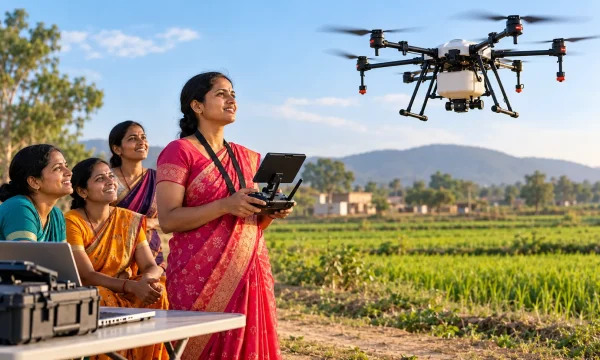
Namo Drone Didi (for women in rural areas): This Central Sector Scheme provides an 80% capital subsidy (up to Rs. 8 lakhs) on a complete agricultural drone package for women-led Self Help Groups. The package includes a 15-day certified training programme entirely at government expense. For eligible women in rural India, the training cost is effectively zero.
SMAM (Sub-Mission on Agricultural Mechanization): Provides 40 to 75% subsidy on drone procurement for farmers and FPOs. Does not directly cover training fees but reduces the overall capital burden.
PMKVY 4.0 (Pradhan Mantri Kaushal Vikas Yojana): Funds specific drone-related vocational courses at subsidised or free rates, including Drone Service Technician and Drone Monitoring and Maintenance Technician roles. Check your state’s Skill India portal for available batches.
RPTO merit scholarships and early-bird discounts: Many institutes offer partial fee waivers. It is worth asking directly before assuming the listed price is fixed.
Can You Pay in Instalments?
Yes. Several financial technology companies offer EMI options specifically for drone training fees.
GrayQuest: Offers Zero Cost EMI, breaking a Rs. 60,000 fee into monthly payments with the interest absorbed by the platform. Effectively converts a large upfront cost into manageable tranches of around Rs. 10,000 per month.
Propelld: Provides Step-Up EMI loans where the repayment starts low during training and early employment, then scales up as your income grows. Designed for the earning trajectory of vocational students.
Both options make the training investment accessible for students without large upfront savings.
What Does Renewal Cost After 10 Years?
The RPC is valid for 10 years. Renewal is not automatic. Here is what it costs.
| Renewal Cost Item | Estimated Range |
|---|---|
| Refresher training at an RPTO | Rs. 15,000 to 30,000 |
| Fresh medical fitness certificate | Rs. 3,000 to 5,000 |
| Administrative processing | Rs. 2,000 to 5,000 |
| DGCA renewal fee | Rs. 100 |
| Total renewal budget | Rs. 20,000 to 40,000 |
Spread over 10 years, this works out to Rs. 2,000 to Rs. 4,000 per year in maintenance cost. That is exceptionally low compared to any other aviation certification.
How Drone Certification Compares to Other Aviation Careers
To put the investment in perspective, here is how the drone RPC compares to the two other main aviation career routes in India.
| Aviation Certification | Training Cost | Duration | Mid-Career Annual Earnings | Break-Even Timeline |
|---|---|---|---|---|
| Drone Pilot (RPC) | Rs. 75,000 | 5 to 7 days | Rs. 15 to 40 lakhs | 2 to 3 months |
| Commercial Pilot (CPL) | Rs. 40 to 50 lakhs | 18 to 24 months | Rs. 25 to 60 lakhs | 3 to 5 years |
| Aircraft Maintenance (AME) | Rs. 15 to 20 lakhs | 2 to 4 years | Rs. 8 to 20 lakhs | 4 to 6 years |
The annualised return on investment for drone certification is exceptional. A pilot earning Rs. 40,000 per month from a starting salary of Rs. 25,000 to 45,000 recovers a Rs. 75,000 training investment within two to three months. That yields an annualised ROI of 400 to 600 percent, which no other aviation pathway comes close to matching.
FAQs
The DGCA charges Rs. 100 for the Remote Pilot Certificate. All other costs are private: RPTO training fees, medical certificate, insurance, and any administrative service charges from consultants.
No. DGCA-approved RPTOs provide all training hardware as part of the course fee. Buying your own drone is a separate, post-certification business decision.
Location, infrastructure quality, instructor credentials, drone fleet quality, and what is included in the fee (accommodation, transport, meals) all drive the difference. Very low prices often mean outdated equipment, less individual flying time, or hidden transport costs.
Yes. Women in rural areas may qualify for fully subsidised training under the Namo Drone Didi scheme. PMKVY 4.0 funds some drone technician courses for free. Some RPTOs offer merit scholarships. It is worth checking state Skill India portals and asking your RPTO directly.
Renewal typically costs Rs. 20,000 to Rs. 40,000 covering a refresher course, a fresh medical certificate, and administrative processing. The DGCA's own fee is Rs. 100.
Yes. Platforms like GrayQuest offer Zero Cost EMI and Propelld offers Step-Up loans specifically for vocational training fees. Many RPTOs have partnerships with these providers.
Rarely. Most RPTO fees cover training only. Third-party liability insurance is a separate annual expense of Rs. 5,000 to Rs. 15,000 that is legally mandatory before you fly commercially.
Summary
The honest answer to how much drone certification costs in India in 2026 is this: the government charges almost nothing. The training is what costs money, and that varies significantly based on where you train, which category you certify for, and what the institute includes in its quoted fee.
For most independent students, a complete budget of Rs. 55,000 to Rs. 90,000 will cover everything: training, medical certificate, government fees, travel, and one year of mandatory insurance.
The return on that investment is faster than almost any other vocational or professional certification in India. At an entry salary of Rs. 25,000 to 45,000 per month, most pilots recover the cost within the first quarter of working.
If you want to understand exactly what our course at CIGPL includes and what you would pay, visit our Remote Pilot Certificate course page for full details. And if you want to see our complete range of training options across categories and specialisations, our drone training page has the full picture.
The investment is modest. The returns are real. And the path from zero to certified takes less than two weeks.